- The fill valve and flushing closure do different jobs; a refill pattern does not identify the failed part.
- A dry floor can coexist with water passing from tank to bowl.
- Meter volume belongs to the connected supply boundary, while billed volume has its own period and read status.
- Retain the finding, work and ordinary follow-up without inventing all-day loss or a refund.
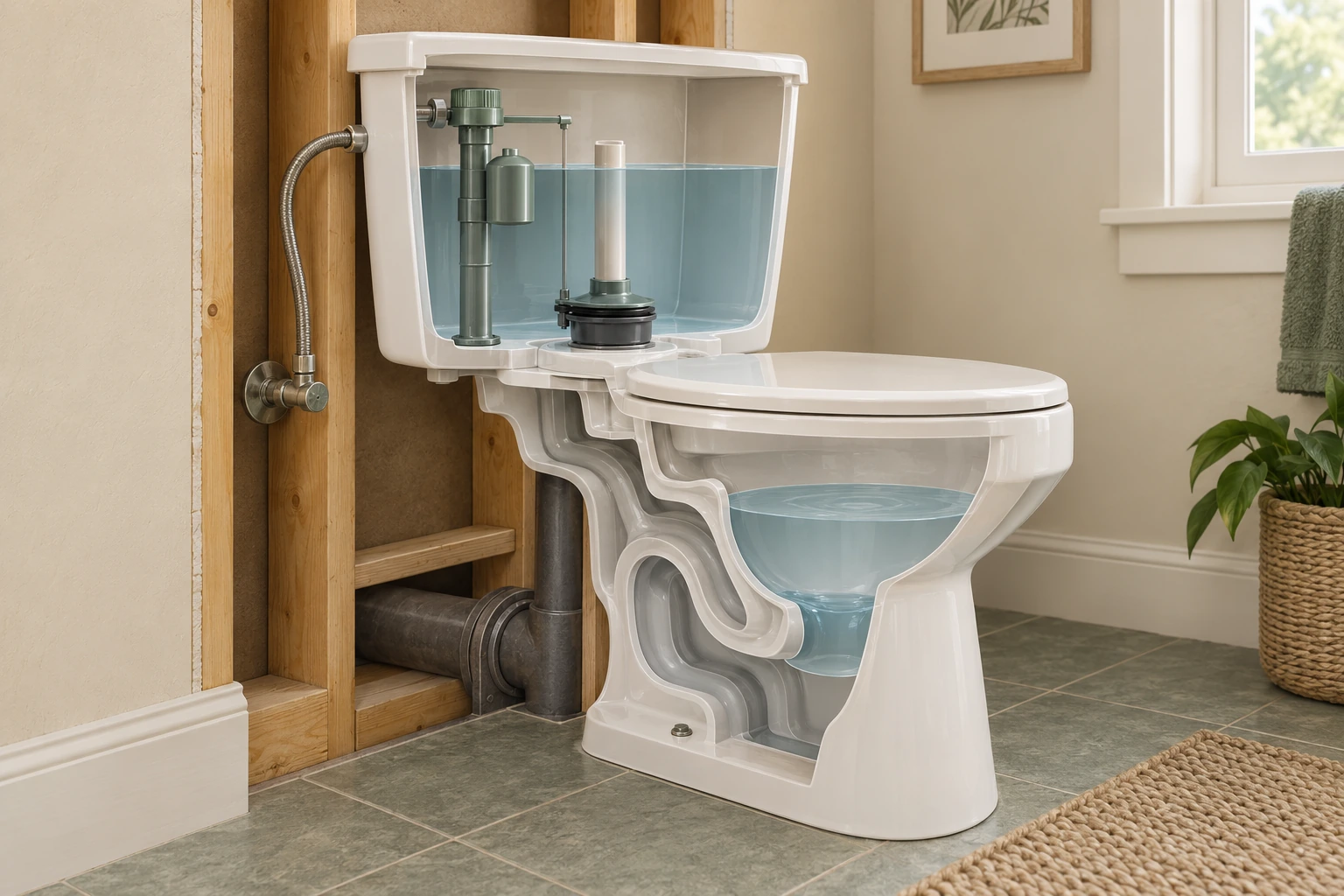
The separate tank and bowl spaces help explain where stored water and replacement water belong.
About this illustration
Hidden connections, actual valve design and any fault remain unknown. Ask which mechanism the actual model uses. This is a conceptual teaching model, not an assessment of your home.
4 picture lessons appear beside the questions in this guide. Use them to understand the explanation, then consider what it means for your home.
How can a toilet lose water while the floor stays dry?
A conventional gravity toilet stores water in its tank. The flush valve releases it into the bowl, and the fill valve supplies replacement water. Between flushes, the tank’s closure should retain that stored water. If water keeps passing into the bowl, it can leave through the drain without wetting the bathroom floor.
The two valves have different jobs: one controls incoming water, while the other closes the flushing passage. A flapper or a canister seal can perform the closing job in different designs. Pressure-assisted and electronic toilets have other arrangements; their parts and service procedures need the actual model.
Start with the ordinary observation: this toilet refills between uses, or its bowl water keeps moving. That gives the plumber a useful question. A dry floor does not tell you how well the tank retains water, and the sound alone does not identify which part needs work.
Water on the floor, an unusually rising bowl or suspected sewage is a separate concern. Stop using a fixture that may overflow and obtain prompt help. Stay clear of contamination and water near electrical equipment. Do not open a pressure vessel or dismantle the toilet to complete this guide.
The tank, fill valve and flush closure have different jobs
The separate tank and bowl spaces help explain where stored water and replacement water belong.
Numbers identify the parts explained below.
- Tank
The tank stores water for an ordinary flush in this conventional gravity arrangement.
- Fill valve
The upright green form represents the replacement-water job, rather than a diagnosed faulty part.
- Flush closure and bowl
The separate closure retains tank water between flushes; the bowl receives water when the flushing passage opens.
What does this illustration leave out?
Hidden connections, actual valve design and any fault remain unknown. Ask which mechanism the actual model uses. Selective original conceptual cutaway. The still picture demonstrates no leak, flow direction or approved assembly. Do not dismantle equipment to match it.
Which part retains water between flushes, and which part controls incoming water in my actual model?
Explore this with HomeAI ↗Opens an editable question. Nothing is sent until you choose to send it.Is it filling after a flush, or refilling between uses?
After an ordinary flush, the fill valve replaces water and then stops. An unexpected refill begins without a reported flush. Continuous running means that sound or flow did not stop during the period you actually watched or listened. These are useful descriptions of different patterns.
A tank that loses retained water may call for another refill. A filling mechanism that does not stop can send water through an overflow passage. Kohler describes several possible mechanisms for its identified products. Similar sounds can therefore need different work; do not order a particular replacement part from the sound alone.
Record the bathroom, what happened beforehand and the start or end you actually witnessed. Heard twice overnight is more precise than ran all night. Quiet during a short visit does not exclude a later event. Do not repeatedly flush or manipulate the handle to manufacture a clearer symptom.
Describe the refill you actually noticed
The three refill patterns show why it helps to record a flush, a later refill and the period you noticed.
Numbers identify the parts explained below.
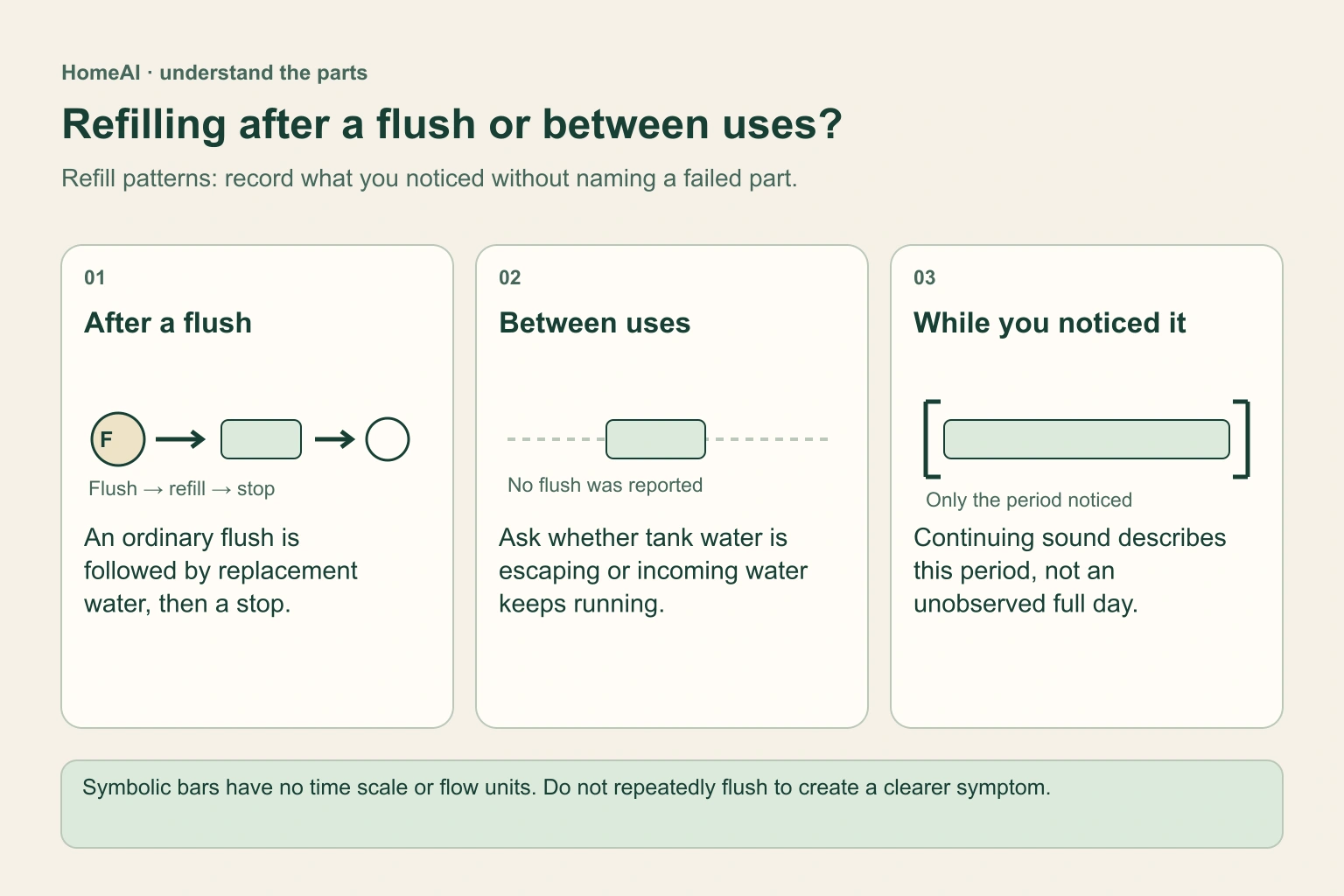
- After an ordinary flush
The flush releases tank water. The fill valve supplies replacement water and then stops in this conceptual ordinary sequence.
- A refill between reported uses
Ask whether tank water is escaping or incoming water keeps running. The actual model and assessment establish what happened.
- While you noticed it
A continuous sound describes only the period you noticed. It does not establish all-day flow, a measured rate or which component needs work.
What does this illustration leave out?
The pattern alone does not identify a component or establish how the toilet behaved outside the recorded window. Qualitative information diagram only. No owner test, deliberately repeated flush or measured timeline is supplied.
Did I notice one refill, two events or continuing sound during a known period?
Explore this with HomeAI ↗Opens an editable question. Nothing is sent until you choose to send it.Read the complete picture lesson
Describe the refill you actually noticed
A refill after a flush, a later unexpected refill and continuing sound during the period you noticed answer different questions. Describe the refill before naming a replacement part.
- After an ordinary flush
- The flush releases tank water. The fill valve supplies replacement water and then stops in this conceptual ordinary sequence.
- A refill between reported uses
- Ask whether tank water is escaping or incoming water keeps running. The actual model and assessment establish what happened.
- While you noticed it
- A continuous sound describes only the period you noticed. It does not establish all-day flow, a measured rate or which component needs work.
Water can pass from the tank into the bowl without reaching the floor. Incoming water that keeps running can create another pattern. Record the bathroom, ordinary surrounding activity and times actually noticed; do not repeatedly flush or manipulate equipment to produce a symptom.
What remains unknown: No measured rate, faulty component, all-night duration, product procedure or water-damage finding is established.
Useful next question: Did I notice one refill, two events or continuing sound during a known period?
Start with the pattern you actually noticed
- Filling after a flushAn ordinary flush followed by its refill. · A later unobserved event or the condition of every part.
- Unexpected refillWhich toilet, no reported flush and the time heard. · The failed part or continuous all-day operation.
- Continuous sound or bowl rippleThe period and behaviour actually observed. · A measured flow or a universal repair choice.
What can I record without opening the toilet?
Use existing paperwork or a safely accessible exterior label to identify the toilet. Note ordinary refill sounds, bowl ripples, reported handle behaviour and the time you noticed them. Mark which details you saw or heard yourself. A photograph can preserve visible water movement, but it cannot establish how long a sound continued.
Model identification makes the manufacturer’s instructions useful. Kohler Canada’s support gateway directs readers toward product support, technical information and service parts. A support page is a starting point; the matching manual still matters. The historical K-3466/K-3467 manual linked here belongs only to those identified models.
Leave heavy covers, pressure vessels, electrical toilet parts and supply connections alone for this record. If safe access or identification is unclear, ask the manufacturer or plumber to help. Keep a refill complaint separate from wet-floor and drainage observations so one concern does not hide another.
What can the water meter tell me about this toilet?
The meter records water passing through its connected supply boundary. It may include the toilet, taps, laundry and automatic equipment. A change during an apparently quiet period raises a whole-meter consumption question; it does not allocate that water to the bathroom where you heard a refill.
Follow the local utility’s guidance for the installed meter. Keep the readings, units, times and known household uses together. Calgary shows different register faces and increments. An unfamiliar dial or a phone photo becomes a volume record only when its scale and the relevant reading are understood.
Ask whether irrigation, a humidifier, a softener or another automatic demand was active. No visible movement during a short visit can also miss an intermittent event or a change below the display’s resolution. For a shared meter, coordinate with the responsible manager; do not call the result one unit’s leak rate.
This observation needs no utility-seal handling, wiring access or unfamiliar valve operation. If meter access or the no-demand conditions cannot be established safely, leave that task to the utility or qualified provider. The useful output is the actual interval and its limitations.
The meter sees several water uses
One shared supply branches toward several illustrated uses; the toilet is one possible demand within that boundary.
Numbers identify the parts explained below.
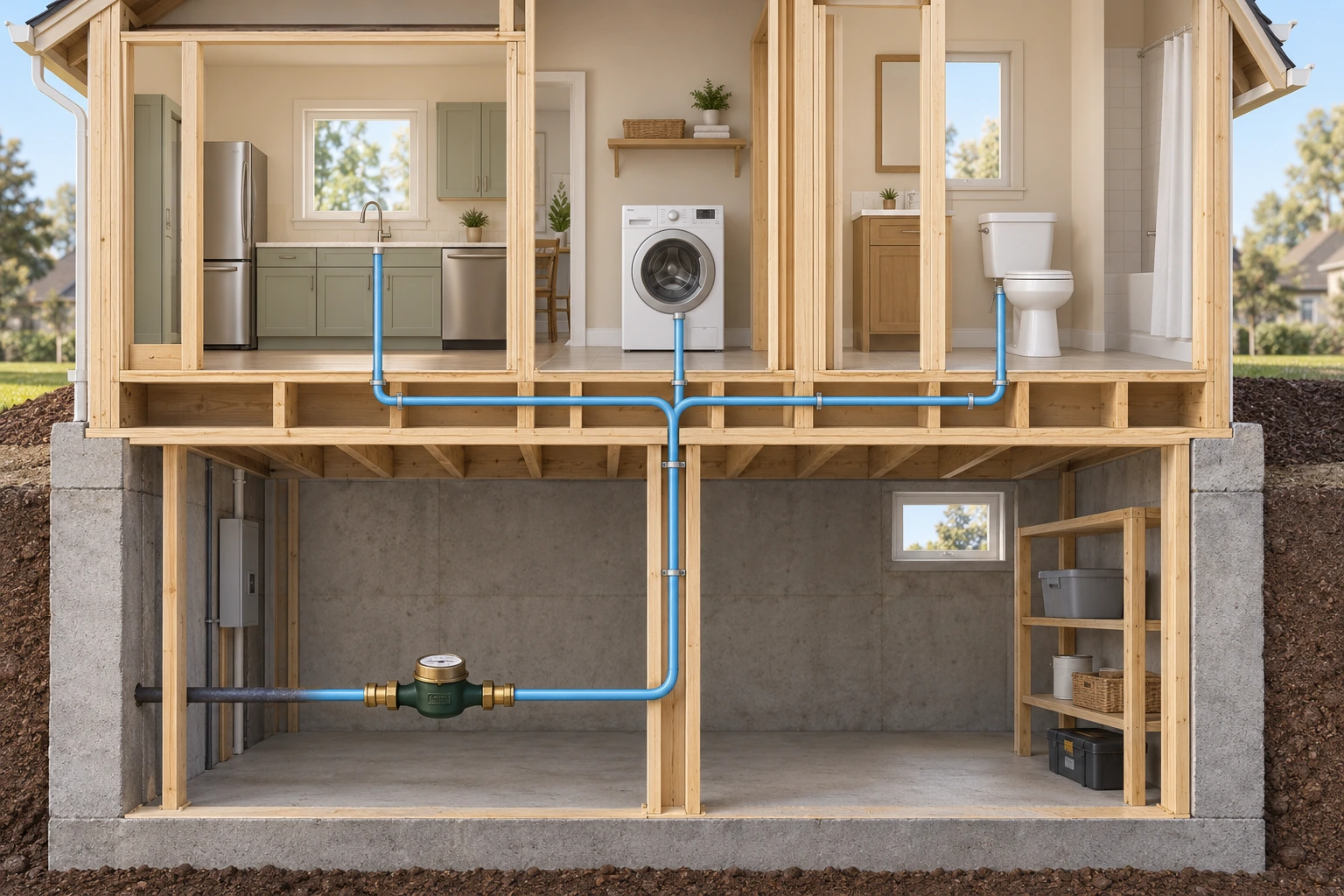
- Meter boundary
A reading belongs to the supply that passes through the identified meter.
- Other connected uses
Laundry, taps and automatic demands can matter during a whole-meter interval.
- The toilet question
A refill observation at one toilet does not assign every litre through the meter to that fixture.
What does this illustration leave out?
The actual meter, units, connected uses and any fixture allocation need identification. No measured use is shown. Original conceptual water-boundary picture. Pipes and connection details are simplified teaching forms, not an installation drawing.
Which known and automatic uses were connected during my recorded interval?
Explore this with HomeAI ↗Opens an editable question. Nothing is sent until you choose to send it.What does a tank-to-bowl colour check answer?
A compatible colour-transfer check asks whether tank water reached the bowl without a flush under the stated conditions. Calgary publishes a current method, while its historical illustrated guide uses different timing. Do not combine the two into a new procedure or assume either suits every toilet.
Check the installed model’s instructions with the current utility guidance, and ask the manufacturer or plumber about compatibility and safe access. This guide supplies no tank-opening step, additive, dose or waiting time. Avoid improvised chemicals and cleaning tablets as substitutes for an approved method.
If a check was performed appropriately, record the method, time and any interruption. Transfer supports that narrow tank-to-bowl question. It does not measure volume or identify every possible seal, valve or control problem. A negative observation also stays limited to the conditions and period checked.
How does a small continuing flow add up?
Volume equals rate multiplied by time. In an invented arithmetic example, a meter records 9 litres over 30 minutes. Dividing gives an average of 0.3 litres per minute across that meter during that interval. This is a fictional teaching value, not a typical toilet leak rate.
If the same rate continued for an entire 24 hours, the conditional total would be 432 litres, or 0.432 cubic metres. The observation covered 30 minutes; the full day is an assumption. Keep those two statements beside each other so an estimate does not start looking like a measured daily loss.
An intermittent source produces periods of flow and quieter periods. A straight cumulative-volume line assumes continuing flow, while a pause makes the line level. Neither shape identifies a toilet component. Other connected uses remain possible even when the arithmetic is correct.
Use a calculation to explain scale, then return to the actual question: what flowed during the observed period, and which fixture mechanism was assessed? The example establishes no historical loss, tariff, repair price or bill adjustment entitlement.
Keep the observed interval beside the longer assumption
The maths shows how rate and time combine. The full day needs a separate assumption that the average stays unchanged.
Numbers identify the parts explained below.
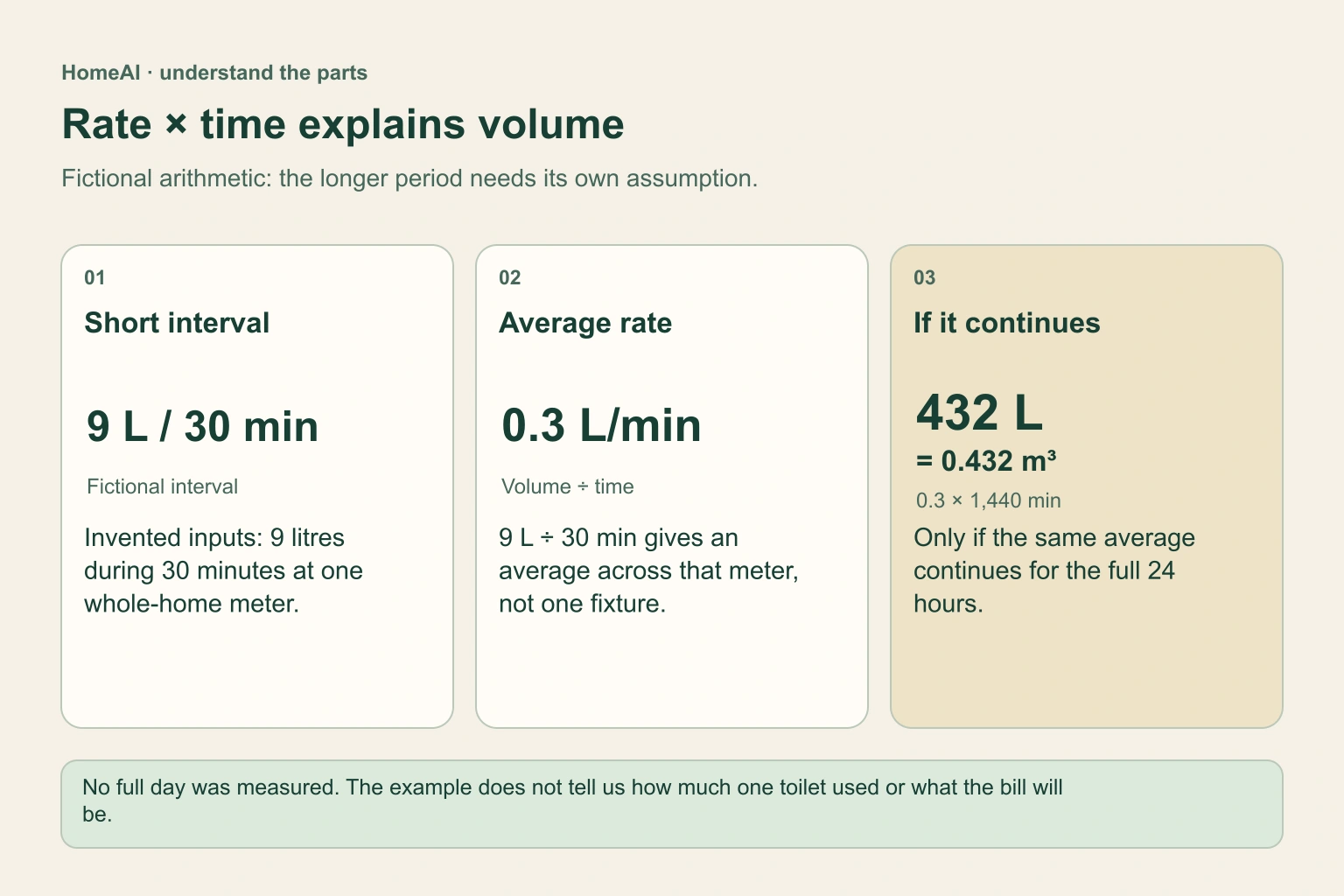
- Fictional interval: 9 L in 30 min
An invented whole-meter example supplies 9 litres over 30 minutes. It is not a measured property result or a typical toilet leak rate.
- Average rate: 0.3 L/min
Divide the interval volume by its time: 9 L ÷ 30 min = 0.3 L/min. Other connected water uses may contribute to that meter volume.
- If it continues: 432 L
Only if that same average continued for 1,440 minutes would the result be 432 L, or 0.432 m³, over 24 hours. The full day was not measured.
What does this illustration leave out?
No full day or one-toilet use was measured. Ask which duration you actually recorded and whether the same flow continued. Invented arithmetic teaching example. Units are L, min, L/min and m³. The 24-hour extension assumes an unchanged average, not an actual measurement or sourced population statistic.
Which part of my result was recorded, and which part assumes continuing flow?
Explore this with HomeAI ↗Opens an editable question. Nothing is sent until you choose to send it.Read the complete picture lesson
Keep the observed interval beside the longer assumption
Volume equals rate multiplied by time. This invented example separates a short calculation from a longer period that was not measured.
- Fictional interval: 9 L in 30 min
- An invented whole-meter example supplies 9 litres over 30 minutes. It is not a measured property result or a typical toilet leak rate.
- Average rate: 0.3 L/min
- Divide the interval volume by its time: 9 L ÷ 30 min = 0.3 L/min. Other connected water uses may contribute to that meter volume.
- If it continues: 432 L
- Only if that same average continued for 1,440 minutes would the result be 432 L, or 0.432 m³, over 24 hours. The full day was not measured.
The 30-minute interval and 9-litre volume are fictional inputs. Their average is 0.3 litres per minute. An unchanged average for 24 hours gives 0.3 L/min × 1,440 min = 432 L = 0.432 m³. Pauses or another connected use change the interpretation. Keep the actual interval and the assumption of continuing flow together.
What remains unknown: No full day was measured. This example does not tell us how much one toilet used, what the bill will be or which repair or refund applies.
Useful next question: Which part of my result was recorded, and which part assumes continuing flow?
Why can a higher bill need a separate explanation?
Read the billed volume, dates and read status before comparing the amount due. Calgary’s explanation distinguishes actual readings, estimates, consumption periods and fixed charges. A larger payment can involve a change in use, a different billed period or a correction to earlier estimates.
When a later actual reading replaces an estimate, the bill can reconcile an earlier difference. Ask the utility which period and readings were adjusted. A bill issued after a repair can still include days before that work. Its issue date is not automatically the start or end of a leak.
Put your observation and service dates beside the account’s consumption period. Keep unresolved billing questions for the utility and fixture questions for the plumber. This guide does not supply a Canadian tariff, refund policy or promised saving; those need the applicable provider and account review.
One concern can need two different conversations
- Toilet behaviour and product identityPlumber or manufacturer: which mechanism and model apply? · The sound does not establish a component finding.
- Whole-meter interval and unitsUtility or authorized provider: what reading and boundary apply? · Meter volume is not automatically this toilet’s volume.
- Bill period and actual/estimated statusUtility: which use period or adjustment was billed? · A later bill date does not locate a leak onset.
Which questions belong to the plumber, utility or manager?
Give the plumber the identified toilet, refill pattern and ordinary observations. Ask which mechanism was established, which component is involved and what the visit did not assess. A clear assignment is investigate refilling between uses, rather than replace the flapper before the product and cause are known.
Use the utility for meter identity, reading interpretation and billing dates. EPCOR’s Edmonton page separates fixture maintenance from utility metering responsibilities. Confirm your own provider’s arrangement instead of exporting Edmonton’s boundary to every Canadian home.
In a rental or condominium, ask the manager who authorizes access and work, especially around shared equipment. Do not force a stiff valve or operate an unfamiliar shared shutoff to isolate a suspected source. Ask the appropriate provider which ordinary controls and response instructions apply.
An internal toilet repair, a meter review and a water-damage investigation are different scopes. If another concern remains, ask who can assess it and why. Keep the work request connected to the observed problem rather than expanding an invoice into a whole-home clearance.
What does a fictional intermittent-refill case teach?
Fictional owner Maya hears the ensuite toilet refill twice overnight without a reported flush. She notices one subtle bowl ripple, and the floor is dry. Her next bill is higher and follows an estimated reading. These facts raise two questions: what is the toilet doing, and what billing period changed?
Maya records the times she heard, retrieves existing product information and asks the utility to explain the readings. She asks a plumber to assess the actual refill mechanism. The story supplies no worn-part finding, measured fixture flow, repair cost or reimbursement.
If work is completed, Maya keeps the stated finding, component and scope with the date. Comparable ordinary-use observations can then show whether unexpected refilling was noticed again. Any unassessed moisture, intermittent event or account adjustment keeps its own remaining question.
How do I close the question after service?
Keep four things together: the original symptom, the confirmed finding, the completed work and the follow-up. The service record should name the toilet and component. A generic plumbing invoice does not explain which refill concern was addressed or which other connections were checked.
If refilling returns, describe the new event and share the previous scope. Do not assume that recurrence proves the earlier work was wrong. If consumption remains high, review the account dates and other uses with the utility. One repaired fixture does not explain every whole-meter change.
A seller can share this bounded history; a buyer can ask what work and follow-up it contains. HomeAI can help organize a service brief and a separately consented HAUSE request. Keep personal account numbers and sensitive documents out of public chat; the useful brief names the fixture, pattern, work and remaining question.
Practice the distinction.
Maya separates two refill events from a bill change
Fictional learning scenario: unexpected ensuite refills and a higher bill following an estimated period are noticed together.
Reported observations
- Two refill times were heard without a reported flush.
- One bowl ripple was seen; the floor was dry.
- The later bill includes an actual read.
- No fixture cause or historical leak volume is verified.
Compare the explanations
Expand each possibility to see the evidence needed to distinguish it. Similar symptoms can have different mechanisms.
The toilet mechanism needs assessment
The pattern raises a tank-retention or continuing-fill question.
Product identity and a plumber’s scoped finding.
The bill contains another period’s reconciliation
A later actual reading may correct an earlier estimate.
The utility’s actual explanation of readings, dates and adjustments.
A useful next question
Ask the plumber and utility their separate questions, then retain work and comparable ordinary follow-up.
No presumed failed part, measured fixture rate, historical loss, tariff, refund or national repair procedure.
Know what the words mean.
- Fill valve
- The part that supplies replacement water to an identified tank toilet; its design depends on the model.
- Flush closure
- The seal or closing part intended to retain tank water between flushes, such as an identified flapper or canister seal.
- Post-flush refill
- Replacement water supplied after an ordinary identified flush, distinguished from a later unexpected refill.
- Read status
- The utility’s description of a meter reading, such as actual or estimated.
- Conditional extrapolation
- A calculation extending an observed average only if its assumed rate and duration continue to apply.
Questions to bring
to the conversation.
- Which toilet and matching product instructions are identified?
- Was the fill after a flush, between uses or continuing during the observed period?
- What readings, units, times and connected uses explain the whole-meter observation?
- Which bill period and actual/estimated status apply?
- Which mechanism was assessed, what work was completed and what follow-up exists?
Separate a showing observation, an existing record and a new professional assessment. Unknown means a question remains; it does not automatically mean a defect.
Use the evidence planner ↗Go to the source.
Original HomeAI explanation informed by these public references. Sources support the underlying guidance; they have not reviewed or endorsed HomeAI. Diagrams are conceptual, and calculator outputs depend on your inputs.
References read for this refresh on October 5, 2026. Calgary guidance is local; historical PDF and current colour-check timings remain separate. Kohler historical model/manual and support-index scope are explicit. Numeric example is invented, conditional and whole-meter. EPCOR responsibility is Edmonton only.
Publication & source review
First published .
Sources reviewed .
- City of Calgary · Water leaks and basic repairs
Where this reference applies
Jurisdiction: Calgary, Alberta
Current municipal tank-to-bowl colour-check and no-demand meter guidance; consult current instructions and actual fixture compatibility. No additive dose, tank-opening, repair or valve-adjustment procedure is reproduced.
- City of Calgary · How to read a water meter
Where this reference applies
Jurisdiction: Calgary, Alberta
Local register scales, cubic metres/litres, reading methods and high-consumption reporting. Model faces differ; the rollout description does not identify a particular property’s meter or data interval.
- City of Calgary · Understanding your water utility bill and water rates
Where this reference applies
Jurisdiction: Calgary, Alberta
Bill dates, meter identity, days billed, actual/estimated read type, reconciliation and usage versus fixed charges. No price, tariff calculation, rebate or adjustment entitlement is reproduced.
- City of Calgary · Toilet leaks and repair illustrated guide
Where this reference applies
Jurisdiction: Calgary, Alberta; historical illustrated guide
Five-page historical fixture illustrations; PDF metadata dates December 2018. Used for conventional/dual-flush relationships and silent transfer only. Its test timing differs from the current web page; no merged timing, historical prices, part lifespan, repair dimensions or code claims are reproduced.
- Kohler · Toilet constantly leaking or running
Where this reference applies
Jurisdiction: Manufacturer guidance for identified Kohler products; no Canadian code determination
One/two-piece toilet symptom and mechanism alternatives, including tank-to-bowl transfer, overflow and continuing fill. The page’s adjustments, disassembly, replacement steps and embedded videos are not reproduced.
- Kohler Canada · Product support
Where this reference applies
Jurisdiction: Canadian manufacturer support
Product identification, model-specific installation/technical documents, support and care resources. The support index is not an installation manual or approval of a universal procedure.
- Kohler · K-3466/K-3467 one-piece toilet homeowner manual 1013211-5-B
Where this reference applies
Jurisdiction: Manufacturer manual with explicit Canada coverage; historical identified K-3466/K-3467 models only
Complete 24-page English/French/Spanish manufacturer manual freshly read; ©2004 back cover and September 15, 2004 PDF metadata. Used for identified-model fill symptoms, alternative mechanisms and manufacturer-specific care limits. Not the current manual for another fixture. No repair, water-level adjustment, cleaner recommendation, service-part selection, warranty entitlement, standard or flush-volume claim is reproduced.
- EPCOR Edmonton · Water pipes on your property
Where this reference applies
Jurisdiction: Edmonton, Alberta
Local fixture/utility responsibility and service referral context. Confirms that meter/fixture questions need distinct contacts; no line-age assumption, insurance claim, curb-control operation or repair adjustment is reproduced.
Have a question about your home?
Start with the symptom, timing and what you have observed.
Ask HomeAI