- Service exchanges hardness ions on resin. Regeneration restores exchange capacity and sends used water away through the documented regeneration route.
- A hardness setting, usage-based remaining quantity and regeneration status describe control inputs or activity. Target-specific entering-and-treated laboratory evidence verifies a different question.
- Keep the exact Canadian-market model/manual and certified claim together. Drinking-water consumption, microbial quality, usable delivery and the receiving drain remain separate enquiries.
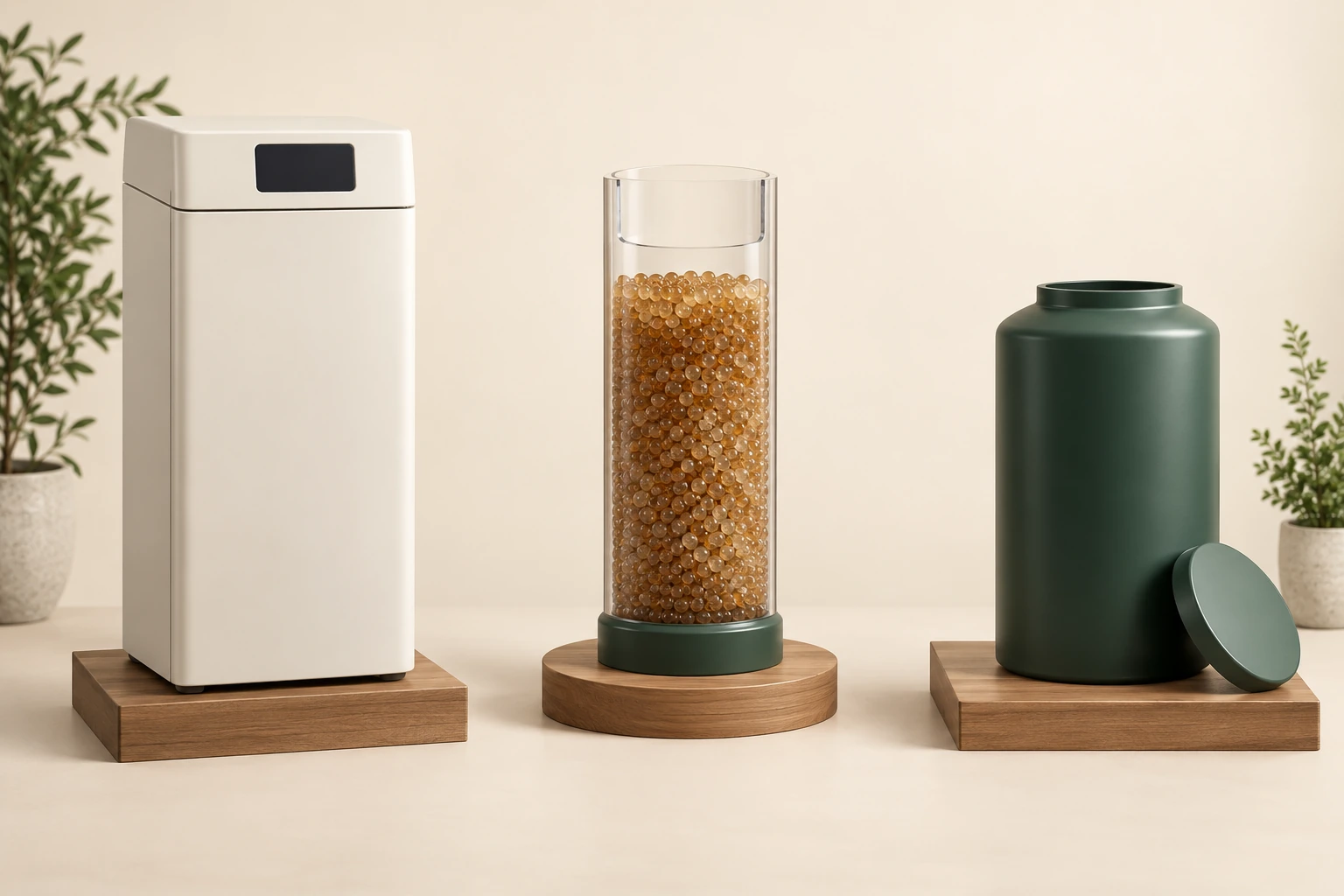
A closed cabinet stands apart from a clear cylinder containing amber bead-like forms and a separate green reservoir-like vessel. Each is on its own stand. The cabinet display is blank, and no connecting pipes or water movement appear.
About this illustration
The detached forms are conceptual function specimens, not an installed internal layout or access instruction. Bead size, colour and arrangement supply no resin identity, exchange capacity or chemistry measurement. The green vessel does not identify a regenerant, dose, actual container or water route. Valve construction, flow direction, branch routing, condition, regeneration state and output-water quality remain unknown. This is a conceptual teaching model, not an assessment of your home.
10 picture lessons appear beside the questions in this guide. Use them to understand the explanation, then consider what it means for your home.
What job does softening actually do?
A cation-exchange softener changes the hardness of the water that passes through its treatment medium. Hardness principally concerns dissolved calcium and magnesium, which can affect soap use and scale formation. That is a specific physical and chemical task. Other dissolved substances, microorganisms and the amount of water available at a fixture need their own questions. An appliance called a softener does not supply a complete drinking-water assessment.
This guide uses WaterBoss 700/900/950 equipment to make the functions concrete. WaterBoss Canada currently links a combined owner’s manual and installation guide, visibly v7.9 with February 17, 2021 page dates, for a stated serial range. The later manual linked by the US site is retained separately: Canadian equivalence is unverified. The Canadian manual also contains conflicting pressure values. Those boundaries matter when matching equipment, so this guide teaches roles without turning either manual into universal Canadian operating instructions. Start with the installed model’s existing paperwork and confirmed applicable manual.
Exchange media and regenerant have different jobs
A closed cabinet stands apart from a clear cylinder containing amber bead-like forms and a separate green reservoir-like vessel. Each is on its own stand. The cabinet display is blank, and no connecting pipes or water movement appear.
Numbers identify the parts explained below.
- Closed cabinet
Match the actual model and manual through existing records. A cabinet face cannot establish its internal construction or delivered treatment.
- Exchange specimen
The source-described resin exchanges hardness ions during service. This separate bead-like model is a role symbol, not a filter screen or a measured molecular picture.
- Regenerant role
Regeneration restores exchange capacity using the documented regenerant process and sends used water away. This separate vessel provides no handling, timing, dose or connection instructions.
What does this illustration leave out?
The detached forms are conceptual function specimens, not an installed internal layout or access instruction. Bead size, colour and arrangement supply no resin identity, exchange capacity or chemistry measurement. The green vessel does not identify a regenerant, dose, actual container or water route. Valve construction, flow direction, branch routing, condition, regeneration state and output-water quality remain unknown. This illustration explains an idea. It is not an installation guide.
Which documented function does the existing status describe, and what current target-specific result is still unknown?
Explore this with HomeAI ↗Opens an editable question. Nothing is sent until you choose to send it.One target, several separate questions
Read the different jobs beside the evidence needed to understand the actual home.
- HardnessSoftening addresses the documented hardness target, principally calcium and magnesium.
- Drinking waterMicrobes, other contaminants and consumption guidance require their own evidence.
- DeliveryUsable flow and supply capacity require a separate delivery enquiry.
No taste, scale, cabinet or fixture observation clears the entire water supply.
Health Canada · Drinking-water operational parameters — final 2025 guideline (Date published March 2025; Page details March 21, 2025. Final guideline, not the 2024 consultation. Catalogue H144-137/2025E-PDF; publication 240720.); Health Canada · Drinking water and health: Treatment (Page details December 5, 2025; initial publication date unstated.); WaterBoss · Models 700/900/950 owner’s manual and installation guide v7.9 (Visible v7.9; manual footers dated February 17, 2021; closing 100242074 RV0221 – Ver 7.9 and ©2018. PDF metadata title says v7.4; visible edition/support binding retained. Initial publication date unstated.). Source bodies reviewed October 4, 2026. Their own dates, models and geographic limits remain in the complete reference panel. Conceptual education supplies no property-specific approval.
How resin changes water during service
During service, water encounters resin beads with exchangeable ions. Calcium and magnesium in the passing water trade places with ions held on the resin. In the cation-exchange process described by NSF, the replacement ions are sodium or potassium, depending on the regenerant used. Hardness ions are retained on the resin while the replacement ions enter the water. The water leaving treatment has undergone an exchange; it has not had every dissolved substance removed.
This is why a hardness target and a broad filter claim need to be read separately. The WaterBoss explanation also discusses a product-specific sediment-filter feature. That added feature should not be generalized into the mechanism of every softener. A resin exchange explanation tells you what the treatment medium is intended to do. It does not establish the exact media installed, the condition of the resin, the chemistry of the incoming water or the result at a particular tap. Those facts belong in the matched service and verification record.
Exchange media and regenerant have different jobs
A closed cabinet stands apart from a clear cylinder containing amber bead-like forms and a separate green reservoir-like vessel. Each is on its own stand. The cabinet display is blank, and no connecting pipes or water movement appear.
Numbers identify the parts explained below.
- Closed cabinet
Match the actual model and manual through existing records. A cabinet face cannot establish its internal construction or delivered treatment.
- Exchange specimen
The source-described resin exchanges hardness ions during service. This separate bead-like model is a role symbol, not a filter screen or a measured molecular picture.
- Regenerant role
Regeneration restores exchange capacity using the documented regenerant process and sends used water away. This separate vessel provides no handling, timing, dose or connection instructions.
What does this illustration leave out?
The detached forms are conceptual function specimens, not an installed internal layout or access instruction. Bead size, colour and arrangement supply no resin identity, exchange capacity or chemistry measurement. The green vessel does not identify a regenerant, dose, actual container or water route. Valve construction, flow direction, branch routing, condition, regeneration state and output-water quality remain unknown. This illustration explains an idea. It is not an installation guide.
Which documented function does the existing status describe, and what current target-specific result is still unknown?
Explore this with HomeAI ↗Opens an editable question. Nothing is sent until you choose to send it.Why regeneration is a different water job
As hardness ions accumulate on the example resin, its remaining capacity to soften water diminishes. Regeneration restores exchange capacity: water containing concentrated regenerant allows the resin to take up replacement ions and release retained hardness. The manufacturer describes the removed material leaving with used water, followed by a return to service. Regeneration therefore has a restorative job and a discharge job, distinct from treating incoming water for ordinary household use.
The named controller’s regeneration record includes backwash, brine/slow-rinse, further backwash and refill phases. These names describe different parts of the documented sequence; they do not mean every softener has identical phases or timing. The presence of automatic water use can help explain why a household consumption record needs ordinary-use context. It cannot establish that a particular sound or meter event was regeneration, that the appliance completed it properly or that no leakage occurred. Record an existing observation and its timing; leave identification and performance findings to the matched assessment.
Exchange media and regenerant have different jobs
A closed cabinet stands apart from a clear cylinder containing amber bead-like forms and a separate green reservoir-like vessel. Each is on its own stand. The cabinet display is blank, and no connecting pipes or water movement appear.
Numbers identify the parts explained below.
- Closed cabinet
Match the actual model and manual through existing records. A cabinet face cannot establish its internal construction or delivered treatment.
- Exchange specimen
The source-described resin exchanges hardness ions during service. This separate bead-like model is a role symbol, not a filter screen or a measured molecular picture.
- Regenerant role
Regeneration restores exchange capacity using the documented regenerant process and sends used water away. This separate vessel provides no handling, timing, dose or connection instructions.
What does this illustration leave out?
The detached forms are conceptual function specimens, not an installed internal layout or access instruction. Bead size, colour and arrangement supply no resin identity, exchange capacity or chemistry measurement. The green vessel does not identify a regenerant, dose, actual container or water route. Valve construction, flow direction, branch routing, condition, regeneration state and output-water quality remain unknown. This illustration explains an idea. It is not an installation guide.
Which documented function does the existing status describe, and what current target-specific result is still unknown?
Explore this with HomeAI ↗Opens an editable question. Nothing is sent until you choose to send it.Conceptual service and regeneration functions
Read the different jobs beside the evidence needed to understand the actual home.
- ServicePassing water exchanges hardness ions with replacement ions held on resin.
- Remaining capacityAccumulated hardness reduces the example resin’s ability to keep softening.
- RegenerationConcentrated regenerant restores exchange capacity and removed material leaves with used water.
- Return to serviceThe named process returns to its ordinary treatment function after regeneration.
Functional comparison only; no literal internal port path, simultaneous flow, dose, duration, button sequence or verified installed result.
WaterBoss Canada · How do water softeners work? (Publication/update date unstated; copyright 2026 is not publication evidence.); WaterBoss · Models 700/900/950 owner’s manual and installation guide v7.9 (Visible v7.9; manual footers dated February 17, 2021; closing 100242074 RV0221 – Ver 7.9 and ©2018. PDF metadata title says v7.4; visible edition/support binding retained. Initial publication date unstated.); NSF · Technical requirements of NSF/ANSI 44 (Visible ©2026; publication date/full standard edition unstated. April 21, 2026 PDF creation is metadata only.). Source bodies reviewed October 4, 2026. Their own dates, models and geographic limits remain in the complete reference panel. Conceptual education supplies no property-specific approval.
Keep the different water routes separate
The Canadian example manual distinguishes a regeneration drain from a gravity overflow. The drain carries backwash water as part of regeneration. The overflow is intended to carry away excess water if the tank overfills or the appliance malfunctions. Those roles answer different questions. Water at a visible location cannot identify which route supplied it, and a pipe disappearing behind the cabinet does not establish a suitable receiving connection.
The same manual describes a bypass that can isolate the appliance and allow untreated water around it. Its purpose does not establish its actual position, which branches receive treatment or what reaches the kitchen tap. Use an existing installer’s diagram or a qualified provider’s confirmed route record. Ask separately where regeneration discharge and overflow go, and which local authority or receiving-system professional must confirm the arrangement. Municipal drainage permission and septic compatibility remain site-specific questions; no hose, valve or drain manipulation is needed to prepare them.
Exchange media and regenerant have different jobs
A closed cabinet stands apart from a clear cylinder containing amber bead-like forms and a separate green reservoir-like vessel. Each is on its own stand. The cabinet display is blank, and no connecting pipes or water movement appear.
Numbers identify the parts explained below.
- Closed cabinet
Match the actual model and manual through existing records. A cabinet face cannot establish its internal construction or delivered treatment.
- Exchange specimen
The source-described resin exchanges hardness ions during service. This separate bead-like model is a role symbol, not a filter screen or a measured molecular picture.
- Regenerant role
Regeneration restores exchange capacity using the documented regenerant process and sends used water away. This separate vessel provides no handling, timing, dose or connection instructions.
What does this illustration leave out?
The detached forms are conceptual function specimens, not an installed internal layout or access instruction. Bead size, colour and arrangement supply no resin identity, exchange capacity or chemistry measurement. The green vessel does not identify a regenerant, dose, actual container or water route. Valve construction, flow direction, branch routing, condition, regeneration state and output-water quality remain unknown. This illustration explains an idea. It is not an installation guide.
Which documented function does the existing status describe, and what current target-specific result is still unknown?
Explore this with HomeAI ↗Opens an editable question. Nothing is sent until you choose to send it.Named roles do not prove the actual routes
Read the different jobs beside the evidence needed to understand the actual home.
- Regeneration drainIn the Canadian example, carries backwash water from regeneration.
- Gravity overflowIn the Canadian example, carries excess water if the tank overfills or malfunctions.
- Bypass purposeCan isolate the named appliance and allow untreated water around it.
- Still unknownActual position, branch connections, drinking-tap supply, receiving drain and local compatibility.
No valve operation, hose/drain manipulation, actual route assumption, septic compatibility or local discharge approval.
WaterBoss · Models 700/900/950 owner’s manual and installation guide v7.9 (Visible v7.9; manual footers dated February 17, 2021; closing 100242074 RV0221 – Ver 7.9 and ©2018. PDF metadata title says v7.4; visible edition/support binding retained. Initial publication date unstated.); Health Canada · Drinking-water operational parameters — final 2025 guideline (Date published March 2025; Page details March 21, 2025. Final guideline, not the 2024 consultation. Catalogue H144-137/2025E-PDF; publication 240720.). Source bodies reviewed October 4, 2026. Their own dates, models and geographic limits remain in the complete reference panel. Conceptual education supplies no property-specific approval.
What a controller record represents
The documented four-button controller shows status and measures water usage for demand-based regeneration. Its remaining-soft-water display describes the quantity remaining until the next automatic regeneration within that control scheme. The hardness input comes from supply-water information, with relevant chemistry considered in the manufacturer’s setup. A setting is information supplied to the controller; usage and phase indicators report other parts of its operation. They should be named accurately in the record.
The manual also distinguishes immediate demand regeneration from a delayed scheduled regeneration, and a capacity-versus-efficiency choice with different regeneration and salt-use trade-offs. These are model-specific control functions, not recommendations to change a setting. A stored photograph of a remaining quantity or cycle indication can help a provider understand the context. It is not an accredited-laboratory result for the current treated water. That conclusion concerns this documented control arrangement; it does not presume that every treatment controller has the same inputs, sensing or display.
A display, a route and a report answer different questions
A closed cream cabinet, an isolated faucet and a folder with blank sheets and a capped bottle occupy separate stands in a dry conceptual utility vignette. The display carries no reading. No pipe connects the cabinet to the faucet or bottle.
Numbers identify the parts explained below.
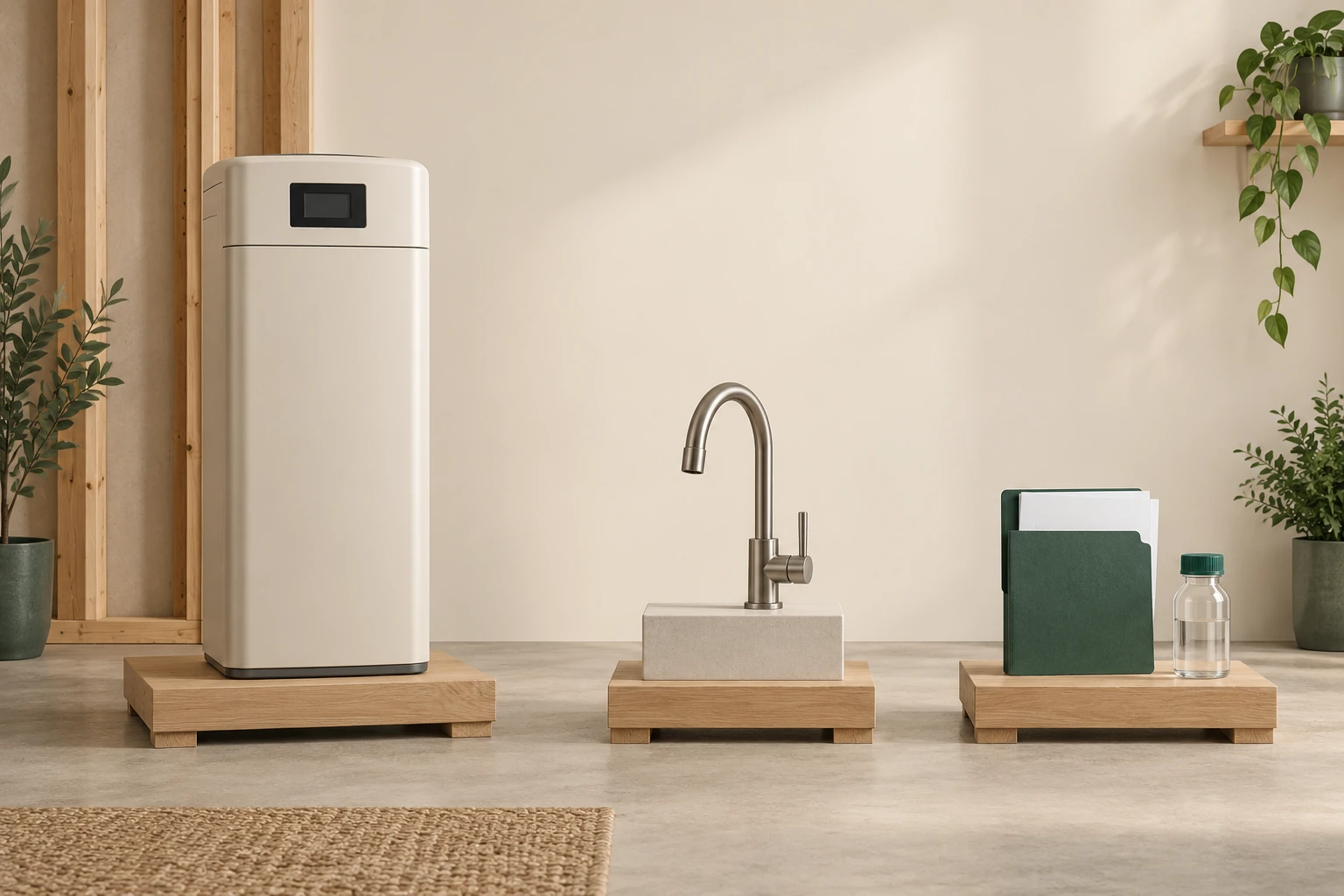
- Existing status
The actual controller may record entered settings, usage and operating state. Match its document; do not manufacture or change a reading for this scene.
- Route question
A drinking tap is a separate actual-route question. No connection, bypass position or consumption suitability follows from these detached props.
- Target-specific result
A real report needs its identified target, location, timing and method. Blank sheets and a bottle establish no treatment success or drinking-water clearance.
What does this illustration leave out?
No existing controller value, installed supply or discharge route, valve position, current chemistry, sample collection, laboratory result or treatment outcome is shown. The bottle is a report-role symbol rather than verified collected water or sampling instructions. A controller account does not become an output-water result, and the faucet’s presence does not prove which water reaches a drinking tap. This illustration explains an idea. It is not an installation guide.
Which record is available, which actual route is documented, and what remains outside the reported test?
Explore this with HomeAI ↗Opens an editable question. Nothing is sent until you choose to send it.Input, controller record and measured result
Read the different jobs beside the evidence needed to understand the actual home.
- Entered informationThe named hardness setting comes from source-water information and relevant chemistry.
- Usage/controlThe named controller measures usage and governs regeneration within its documented modes.
- Status/remaining quantityReports a control state or quantity within that scheme.
- Target verificationAccredited-laboratory entering-and-treated evidence answers whether the unit meets its treatment target.
No unseen-code diagnosis, correct-setting prescription, universal sensor claim or current output result inferred from a screen.
WaterBoss · Models 700/900/950 owner’s manual and installation guide v7.9 (Visible v7.9; manual footers dated February 17, 2021; closing 100242074 RV0221 – Ver 7.9 and ©2018. PDF metadata title says v7.4; visible edition/support binding retained. Initial publication date unstated.); Health Canada · Drinking-water operational parameters — final 2025 guideline (Date published March 2025; Page details March 21, 2025. Final guideline, not the 2024 consultation. Catalogue H144-137/2025E-PDF; publication 240720.). Source bodies reviewed October 4, 2026. Their own dates, models and geographic limits remain in the complete reference panel. Conceptual education supplies no property-specific approval.
Why a rating remains conditional
Capacity and efficiency belong to stated rating conditions. In the Canadian manual, laboratory-rated efficiency is distinguished from the operating efficiency achieved after installation. The manufacturer identifies water hardness, water use and other contaminants as factors affecting the installed result. A rating therefore needs its exact model, test conditions and claim alongside it. A remaining quantity on the screen does not show that a household achieved a published efficiency or that the output meets its target today.
Certification has a similarly specific meaning. Health Canada says verified performance claims are those covered by the applicable standard. The current NSF listings identify the example models under NSF/ANSI 44 and CSA Standard B483.1, with hardness reduction and particular other listed claims. NSF’s overview distinguishes elective claims such as barium, radium and efficiency. Look up the exact model and claim; a cabinet, logo or historical certificate cannot answer every contaminant question. The manual’s California 2005 certificates are historical evidence, not current Canadian installation approval.
A display, a route and a report answer different questions
A closed cream cabinet, an isolated faucet and a folder with blank sheets and a capped bottle occupy separate stands in a dry conceptual utility vignette. The display carries no reading. No pipe connects the cabinet to the faucet or bottle.
Numbers identify the parts explained below.
- Existing status
The actual controller may record entered settings, usage and operating state. Match its document; do not manufacture or change a reading for this scene.
- Route question
A drinking tap is a separate actual-route question. No connection, bypass position or consumption suitability follows from these detached props.
- Target-specific result
A real report needs its identified target, location, timing and method. Blank sheets and a bottle establish no treatment success or drinking-water clearance.
What does this illustration leave out?
No existing controller value, installed supply or discharge route, valve position, current chemistry, sample collection, laboratory result or treatment outcome is shown. The bottle is a report-role symbol rather than verified collected water or sampling instructions. A controller account does not become an output-water result, and the faucet’s presence does not prove which water reaches a drinking tap. This illustration explains an idea. It is not an installation guide.
Which record is available, which actual route is documented, and what remains outside the reported test?
Explore this with HomeAI ↗Opens an editable question. Nothing is sent until you choose to send it.Rating, listing and installed performance
Read the different jobs beside the evidence needed to understand the actual home.
- Laboratory ratingBelongs to the model and stated test conditions.
- Certified claimBelongs to the exact product and claim verified within the standard/listing.
- Installed resultRequires evidence under the actual water chemistry, use and relevant conditions.
No numerical table, savings forecast, universal contaminant removal, Canadian installation approval or potable clearance.
WaterBoss · Models 700/900/950 owner’s manual and installation guide v7.9 (Visible v7.9; manual footers dated February 17, 2021; closing 100242074 RV0221 – Ver 7.9 and ©2018. PDF metadata title says v7.4; visible edition/support binding retained. Initial publication date unstated.); Health Canada · Drinking water and health: Treatment (Page details December 5, 2025; initial publication date unstated.); NSF · Technical requirements of NSF/ANSI 44 (Visible ©2026; publication date/full standard edition unstated. April 21, 2026 PDF creation is metadata only.); NSF · Waterboss official NSF/ANSI 44 listing (Official listing current as of October 4, 2026 at 12:15 a.m. Eastern Time.); NSF · Waterboss official CSA Standard B483.1 listing (Official listing current as of October 4, 2026 at 12:15 a.m. Eastern Time.). Source bodies reviewed October 4, 2026. Their own dates, models and geographic limits remain in the complete reference panel. Conceptual education supplies no property-specific approval.
Which drinking-water questions stay separate?
The example manual says the appliance must be applied to potable water and must not treat microbiologically unsafe or unknown-quality water without adequate disinfection before or after it. Softening does not establish that this requirement has been met. Health Canada’s current treatment guidance directs private-source users to local public-health advice on the contaminants to test and to a qualified treatment specialist when corrective treatment is needed. Keep that source-water work with the private-well guide rather than asking the softener display to settle it.
Consumption also matters because exchange introduces replacement ions. Health Canada’s final March 2025 guideline warns that sodium-form softening may introduce undesirable sodium, and potassium-form softening may introduce potassium that may adversely affect some people. It recommends separate water for consumption and cooking, with frequently consumed water such as the kitchen supply bypassing the softener. Appendix E advises that children under eight generally should not drink water containing sodium from a softener, and that people on sodium-restricted diets should consult their physician. Ask qualified providers to confirm the actual drinking-water route and seek appropriate health advice; do not experiment with the bypass or assume untreated water is potable.
Alternative technologies require their own target and constraints. The same final guideline discusses reverse osmosis and distillation separately, including maintenance and point-of-use limitations, and states that certified systems for their hardness-removal use are unavailable. A product certified for another claim should not acquire a hardness claim by implication. Selecting treatment remains a source-water and target-specific task, not a contest between reassuring appliance names.
A display, a route and a report answer different questions
A closed cream cabinet, an isolated faucet and a folder with blank sheets and a capped bottle occupy separate stands in a dry conceptual utility vignette. The display carries no reading. No pipe connects the cabinet to the faucet or bottle.
Numbers identify the parts explained below.
- Existing status
The actual controller may record entered settings, usage and operating state. Match its document; do not manufacture or change a reading for this scene.
- Route question
A drinking tap is a separate actual-route question. No connection, bypass position or consumption suitability follows from these detached props.
- Target-specific result
A real report needs its identified target, location, timing and method. Blank sheets and a bottle establish no treatment success or drinking-water clearance.
What does this illustration leave out?
No existing controller value, installed supply or discharge route, valve position, current chemistry, sample collection, laboratory result or treatment outcome is shown. The bottle is a report-role symbol rather than verified collected water or sampling instructions. A controller account does not become an output-water result, and the faucet’s presence does not prove which water reaches a drinking tap. This illustration explains an idea. It is not an installation guide.
Which record is available, which actual route is documented, and what remains outside the reported test?
Explore this with HomeAI ↗Opens an editable question. Nothing is sent until you choose to send it.What can an owner record safely?
Gather existing model and service documents, the applicable manual, any existing water-route drawing and laboratory reports. If an exterior status display is already safely visible, record its exact wording or retain an ordinary-use photograph without pressing buttons or removing a cover. Add the time and context of observations made during normal household use. The provider can then separate a controller setting, a reported phase, a consumption history and a water-quality result. A receipt documents its stated work; it does not establish current performance.
Stop ordinary recording when water and electrical equipment create a hazard. Ontario’s Electrical Safety Authority warns that water contacting electrical systems can cause severe shock and identifies dangerous flooded-basement conditions requiring utility assistance. Keep away from dangerous wet access and seek the appropriate emergency, utility or qualified electrical help. Do not handle wet electrical equipment, open panels, move an energized unit or restart flooded equipment. Even in dry ordinary conditions, this guide supplies no valve operation, reset, forced regeneration, salt handling or drain adjustment.
A display, a route and a report answer different questions
A closed cream cabinet, an isolated faucet and a folder with blank sheets and a capped bottle occupy separate stands in a dry conceptual utility vignette. The display carries no reading. No pipe connects the cabinet to the faucet or bottle.
Numbers identify the parts explained below.
- Existing status
The actual controller may record entered settings, usage and operating state. Match its document; do not manufacture or change a reading for this scene.
- Route question
A drinking tap is a separate actual-route question. No connection, bypass position or consumption suitability follows from these detached props.
- Target-specific result
A real report needs its identified target, location, timing and method. Blank sheets and a bottle establish no treatment success or drinking-water clearance.
What does this illustration leave out?
No existing controller value, installed supply or discharge route, valve position, current chemistry, sample collection, laboratory result or treatment outcome is shown. The bottle is a report-role symbol rather than verified collected water or sampling instructions. A controller account does not become an output-water result, and the faucet’s presence does not prove which water reaches a drinking tap. This illustration explains an idea. It is not an installation guide.
Which record is available, which actual route is documented, and what remains outside the reported test?
Explore this with HomeAI ↗Opens an editable question. Nothing is sent until you choose to send it.What should the professional verification deliver?
Ask the matched provider to identify the installed device and applicable Canadian-market edition, then describe its treatment target, control inputs and documented service/regeneration functions. Request a record of the actual drinking-water and discharge routes, including what remains hidden or unconfirmed. Separate a chemistry question from a delivery complaint: hardness, usable flow and a receiving drain are different parts of the assessment. The pressure-observation and plumbing guides help frame a delivery enquiry without attributing a weak stream to the softener.
Health Canada’s residential guidance calls for characterizing source-water chemistry and the parameters of interest, then periodic accredited-laboratory testing of entering and treated water to verify the unit’s effectiveness. The provider, laboratory and relevant public-health service should define the locations, method and scope for this home. A result needs those circumstances to be interpretable. Conductivity also has a limit: Health Canada notes that minerals can contribute to it without contributing to hardness. Keep a generic meter label, a controller quantity and a target-specific laboratory result as distinct records. Ask the completed report to state what was verified, under which conditions, and what remains unresolved.
A display, a route and a report answer different questions
A closed cream cabinet, an isolated faucet and a folder with blank sheets and a capped bottle occupy separate stands in a dry conceptual utility vignette. The display carries no reading. No pipe connects the cabinet to the faucet or bottle.
Numbers identify the parts explained below.
- Existing status
The actual controller may record entered settings, usage and operating state. Match its document; do not manufacture or change a reading for this scene.
- Route question
A drinking tap is a separate actual-route question. No connection, bypass position or consumption suitability follows from these detached props.
- Target-specific result
A real report needs its identified target, location, timing and method. Blank sheets and a bottle establish no treatment success or drinking-water clearance.
What does this illustration leave out?
No existing controller value, installed supply or discharge route, valve position, current chemistry, sample collection, laboratory result or treatment outcome is shown. The bottle is a report-role symbol rather than verified collected water or sampling instructions. A controller account does not become an output-water result, and the faucet’s presence does not prove which water reaches a drinking tap. This illustration explains an idea. It is not an installation guide.
Which record is available, which actual route is documented, and what remains outside the reported test?
Explore this with HomeAI ↗Opens an editable question. Nothing is sent until you choose to send it.A fictional owner separates three records
Fictional learning example: an owner has an old exterior-controller photograph showing a remaining-soft-water label, an ordinary-use diary describing when household water was used, and a report labelled hardness whose sample location is unclear. Existing paperwork identifies a manual family, but the exact installed model and applicable edition still need confirmation. The owner wants to know whether these records demonstrate successful treatment. No new test or equipment operation is assumed.
The photograph preserves a control record at one moment. The diary supplies consumption context without identifying every internal device event or a leak. The report may describe a hardness result, but an unknown sampling point prevents treating it as verified output from this appliance. None establishes the actual drinking-water route, all contaminants or usable delivery. The owner’s useful next step is a scoped request: confirm the model/manual and control inputs, document the routes and arrange the appropriate entering-and-treated verification. The fictional record supports better questions; it supplies no diagnosis, repair approval or declaration that the water is safe to drink.
A display, a route and a report answer different questions
A closed cream cabinet, an isolated faucet and a folder with blank sheets and a capped bottle occupy separate stands in a dry conceptual utility vignette. The display carries no reading. No pipe connects the cabinet to the faucet or bottle.
Numbers identify the parts explained below.
- Existing status
The actual controller may record entered settings, usage and operating state. Match its document; do not manufacture or change a reading for this scene.
- Route question
A drinking tap is a separate actual-route question. No connection, bypass position or consumption suitability follows from these detached props.
- Target-specific result
A real report needs its identified target, location, timing and method. Blank sheets and a bottle establish no treatment success or drinking-water clearance.
What does this illustration leave out?
No existing controller value, installed supply or discharge route, valve position, current chemistry, sample collection, laboratory result or treatment outcome is shown. The bottle is a report-role symbol rather than verified collected water or sampling instructions. A controller account does not become an output-water result, and the faucet’s presence does not prove which water reaches a drinking tap. This illustration explains an idea. It is not an installation guide.
Which record is available, which actual route is documented, and what remains outside the reported test?
Explore this with HomeAI ↗Opens an editable question. Nothing is sent until you choose to send it.Read the fictional records within their limits
Read the different jobs beside the evidence needed to understand the actual home.
- Stored screen photoA remaining-quantity record at one moment.
- Ordinary use diaryConsumption context without identifying every internal event or a leak.
- Hardness reportA result needing a confirmed sample point, time and method.
- Next evidenceMatched model/control record, confirmed routes and appropriately scoped entering-and-treated verification.
Fictional, measurement-free and diagnosis-free; none of these records alone establishes drinking-water quality or delivery.
WaterBoss · Models 700/900/950 owner’s manual and installation guide v7.9 (Visible v7.9; manual footers dated February 17, 2021; closing 100242074 RV0221 – Ver 7.9 and ©2018. PDF metadata title says v7.4; visible edition/support binding retained. Initial publication date unstated.); Health Canada · Drinking-water operational parameters — final 2025 guideline (Date published March 2025; Page details March 21, 2025. Final guideline, not the 2024 consultation. Catalogue H144-137/2025E-PDF; publication 240720.). Source bodies reviewed October 4, 2026. Their own dates, models and geographic limits remain in the complete reference panel. Conceptual education supplies no property-specific approval.
Keep learning about the connected parts
Practice the distinction.
One display, a use diary and an unclear sampling point
Fictional learning scenario: existing records describe a remaining quantity, ordinary household water use and a hardness result, with no new test or equipment manipulation.
Reported observations
- A stored exterior-controller photo preserves a remaining-soft-water label.
- An ordinary-use diary records when household water was used.
- The hardness report does not clearly identify entering water or treated water.
- The model/manual match and actual drinking/discharge routes are unconfirmed.
Compare the explanations
Expand each possibility to see the evidence needed to distinguish it. Similar symptoms can have different mechanisms.
Control activity is documented
The screen and ordinary history can help a matched provider reconstruct context; they do not verify current output chemistry.
Confirmed model/manual, existing control inputs and documented operation context.
The treatment result still needs a scope
A hardness report needs its sampling location, time and method before it can establish this unit’s target performance.
Accredited-laboratory entering-and-treated verification defined with the provider and relevant public-health advice.
A useful next question
Request the exact model/edition, treatment and control record, confirmed routes and a target-specific verification scope.
Fictional and measurement-free; no diagnosis, settings recommendation, potable-water clearance or actual installation approval.
Know what the words mean.
- Hardness
- A water property principally associated with dissolved calcium and magnesium; a specific treatment target, not a whole-water safety verdict.
- Cation exchange
- A process in which positively charged ions in the water exchange with ions held on a treatment medium.
- Resin
- The exchange medium described in the softener example; retained hardness reduces its remaining softening capacity.
- Service
- The documented operating function in which incoming water undergoes softening.
- Regenerant / brine
- The concentrated regeneration solution used by the documented process to restore exchange capacity; this definition supplies no chemical selection or handling instruction.
- Regeneration
- The documented restorative sequence that releases retained material, replenishes exchange capacity and returns the appliance to service.
- Demand-based control
- The named controller’s use of water-consumption information to govern regeneration.
- Remaining-capacity record
- A quantity reported within the named control scheme, distinct from a current measured output-water result.
- Treatment verification
- Target-specific evidence comparing the water entering a unit and its treated water under identified conditions.
- Point of entry / point of use
- Treatment located at a supply entry or a particular use point; the actual connected branches still require confirmation.
- Certified claim
- A particular performance claim verified within the applicable standard and exact product listing, without expanding it to all water-quality questions.
Questions to bring
to the conversation.
- What was actually observed?
- Which part was assessed, and what was inaccessible?
- What record supports the conclusion?
- Who can resolve the remaining technical question?
Separate a showing observation, an existing record and a new professional assessment. Unknown means a question remains; it does not automatically mean a defect.
Use the evidence planner ↗Go to the source.
Original HomeAI explanation informed by these public references. Sources support the underlying guidance; they have not reviewed or endorsed HomeAI. Diagrams are conceptual, and calculator outputs depend on your inputs.
Publication & source review
First published .
Sources reviewed .
- WaterBoss Canada · Owner’s manuals
Where this reference applies
Jurisdiction: Canadian-market manufacturer support
Edition: Current support page links Owner’s Manual v7.9 for models 700/900/950, serial numbers 09440616 and up. Publication/update date unstated; copyright 2026 is not a publication date.
Source reviewed: 2026-10-04 · UTC
Establishes the named Canadian-market manual applicability. Existing documents or the manufacturer should resolve a different serial/model; this is not an instruction to open the cabinet.
- WaterBoss Canada · How do water softeners work?
Where this reference applies
Jurisdiction: Canadian-market manufacturer explanation
Edition: Publication/update date unstated; copyright 2026 is not publication evidence.
Source reviewed: 2026-10-04 · UTC
Resin exchange, diminishing capacity, regeneration and return to service. Patented filtering/packing features and broad clean-water marketing are not generalized to all softeners or drinking-water safety.
- WaterBoss · Models 700/900/950 owner’s manual and installation guide v7.9
Where this reference applies
Jurisdiction: Canadian-market applicability established by WaterBoss Canada’s exact support table
Edition: Visible v7.9; manual footers dated February 17, 2021; closing 100242074 RV0221 – Ver 7.9 and ©2018. PDF metadata title says v7.4; visible edition/support binding retained. Initial publication date unstated.
Source reviewed: 2026-10-04 · UTC
Named whole-device functions, separate drain/overflow/bypass roles and controls. Checklist/specification pressure values conflict; operating numbers and procedures remain outside this guide. US legal text and California 2005 certificates do not establish current Canadian installation approval.
- WaterBoss US · Owner’s manuals — alternate support route
Where this reference applies
Jurisdiction: US manufacturer support; Canadian serial applicability unverified
Edition: Publication/update date unstated; current link uses an April 2025 upload path.
Source reviewed: 2026-10-04 · UTC
Edition comparison only. A later US upload does not automatically supersede the manual currently linked for the Canadian model/serial range.
- WaterBoss US · Models 700/900/950 alternate owner’s manual
Where this reference applies
Jurisdiction: US support-linked manual; Canadian equivalence unverified
Edition: No explicit edition/publication date established on inspected cover/closing pages. April 2025 upload path and April 28, 2025 PDF creation are metadata only.
Source reviewed: 2026-10-04 · UTC
Comparison/uncertainty only. Different conditions/tables and an internal Fahrenheit/Celsius inconsistency remain held; no alternate operating values or Canadian applicability inferred.
- Health Canada · Drinking-water operational parameters — final 2025 guideline
Where this reference applies
Jurisdiction: Federal Canadian drinking-water guidance
Edition: Date published March 2025; Page details March 21, 2025. Final guideline, not the 2024 consultation. Catalogue H144-137/2025E-PDF; publication 240720.
Source reviewed: 2026-10-04 · UTC
Hardness, target-specific entering/treated verification, conductivity limits, current sodium/potassium consumption guidance and bounded alternatives. No numeric operating/clinical prescription, sampling recipe or local discharge approval.
- Health Canada · Drinking water and health: Treatment
Where this reference applies
Jurisdiction: Federal Canadian consumer guidance
Edition: Page details December 5, 2025; initial publication date unstated.
Source reviewed: 2026-10-04 · UTC
Treatment must address a demonstrated target; certification verifies claims within its actual scope. No brand endorsement, universal device recommendation or whole-water clearance.
- Health Canada · Sodium technical document — historical corroboration
Where this reference applies
Jurisdiction: Federal Canadian historical technical document at the current official URL
Edition: Published December 1992; Page details April 25, 2012.
Source reviewed: 2026-10-04 · UTC
Historical qualitative context only. Current household consumption advice comes from the final 2025 operational-parameters guideline; no 1992 clinical threshold, dose or personal-risk conclusion adopted.
- NSF · Technical requirements of NSF/ANSI 44
Where this reference applies
Jurisdiction: Certifier overview of the US cation-exchange standard
Edition: Visible ©2026; publication date/full standard edition unstated. April 21, 2026 PDF creation is metadata only.
Source reviewed: 2026-10-04 · UTC
Cation exchange, known-source/claim scope and elective claims. Technical overview is not the full standard; California efficiency examples are not Canadian law. The landing page was inaccessible; the complete linked PDF was successfully retained and read.
- NSF · Waterboss official NSF/ANSI 44 listing
Where this reference applies
Jurisdiction: Certifier product listing; named manufacturer facility in Ohio
Edition: Official listing current as of October 4, 2026 at 12:15 a.m. Eastern Time.
Source reviewed: 2026-10-04 · UTC
Exact model/claim verification, including hardness reduction and listed elective claims. No numerical performance, California legal transfer, installation approval or actual-water safety clearance.
- NSF · Waterboss official CSA Standard B483.1 listing
Where this reference applies
Jurisdiction: Certifier CSA-scope product listing; not a local installation authority
Edition: Official listing current as of October 4, 2026 at 12:15 a.m. Eastern Time.
Source reviewed: 2026-10-04 · UTC
Specific listed model and treatment claims. A standard name does not approve every contaminant, source-water condition, installation or receiving drain.
- Ontario Electrical Safety Authority · Flood safety
Where this reference applies
Jurisdiction: Ontario electrical safety regulator
Edition: Publication/update date unstated; footer copyright 1999–2026 is not publication evidence.
Source reviewed: 2026-10-04 · UTC
Wet electrical hazard and dangerous-access priority. Ontario licensing, notifications and acceptance procedures are not transferred nationally; no owner repair or restart instruction.
Have a question about your home?
Start with the symptom, timing and what you have observed.
Ask HomeAI