- Record first arrival, collection and weather or vehicle timing as different observations.
- Pale marks, powder, fine patterns and missing material need careful identification; colour and appearance do not establish cause or structural condition.
- Ask about the actual water route, substrate, proposed finish and local discharge rules, with safety and scope kept explicit.
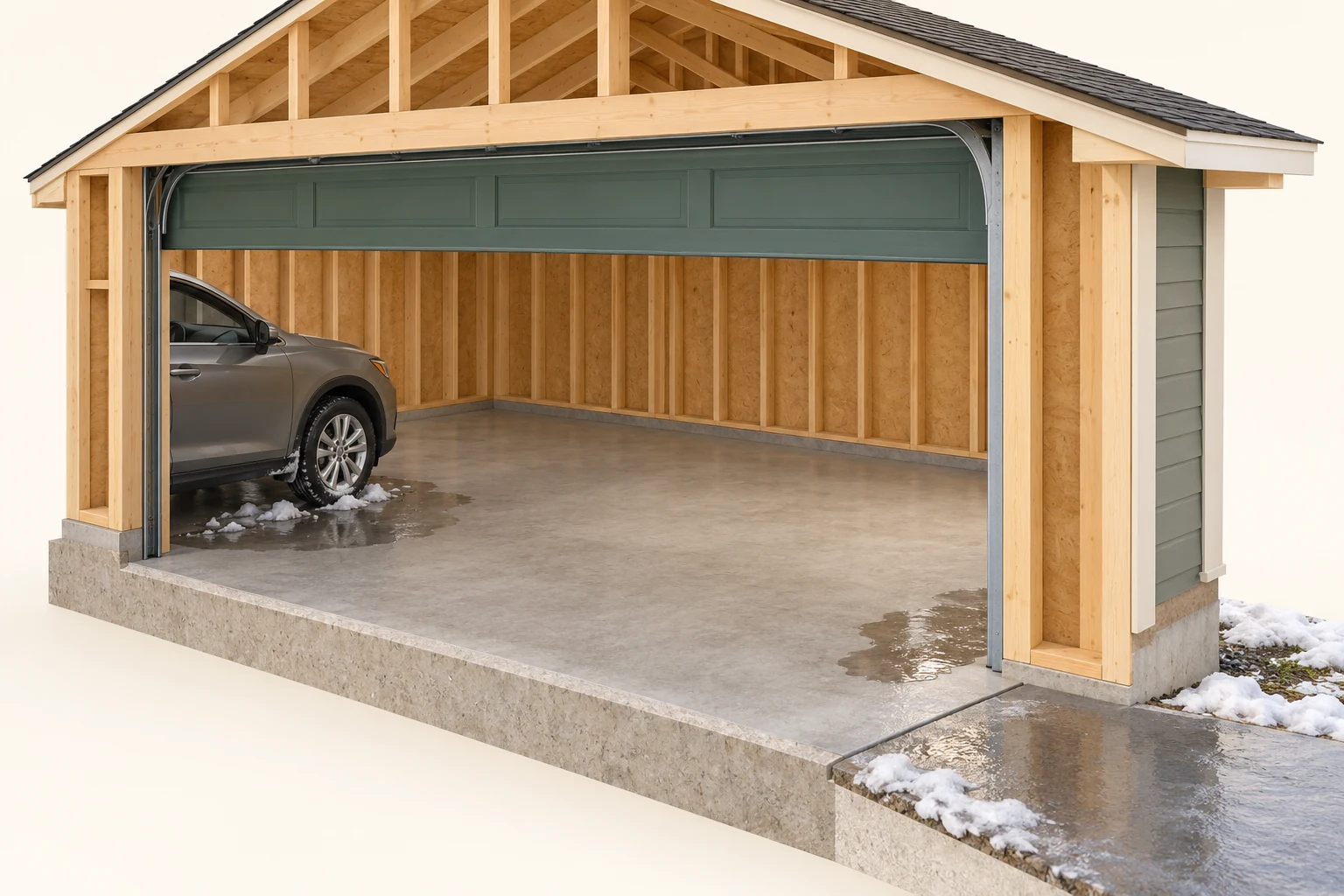
A snowy wheel and nearby wetness, plus wet doorway and outside-apron surfaces; the doorway patches meet in the illustration.
About this illustration
No arrival order, flow direction, engine operation, drainage destination, floor slope, structural assembly or actual property is established. This is a conceptual teaching model, not an assessment of your home.
4 picture lessons appear beside the questions in this guide. Use them to understand the explanation, then consider what it means for your home.
Did this water arrive with the car or near the doorway?
Snow and slush carried on a vehicle can melt after it is parked. Rain or outdoor snowmelt can raise a different question near a garage doorway. These possibilities can coexist. A puddle’s final location alone does not show when the water arrived or which route supplied it.
From a normal safe position, note the first visible wet location and timing: before parking, after a snowy trip or during rain. Describe where water collects separately from where it first appeared. Do not create a hose test, drive onto uncertain surfaces or cross slippery water to get a closer photograph.
The garage cutaway shows wetness near a snowy vehicle and at the doorway and outside apron. The doorway wet surfaces meet in the illustration, but no flow direction is established. The picture is a teaching model rather than an observed property, drainage design or proof of a leak.
Give the provider the location and ordinary weather or vehicle history. A concrete-surface question, a doorway or enclosure question and a site-water question may need different assessment. Begin with that brief before ordering a coating or changing where water drains.
Compare vehicle wetness with doorway wetness
A snowy wheel and nearby wetness, plus wet doorway and outside-apron surfaces; the doorway patches meet in the illustration.
Numbers identify the parts explained below.
- Near the vehicle
The illustrated slush and wetness teach a possible arrival-history question.
- Doorway and apron
Wet surfaces are visible on both sides and meet; record first arrival rather than inferring direction.
- Concrete edge
The model cutaway is illustrative and does not establish thickness, reinforcement or design.
- Safe ordinary record
Note location, parking and weather timing from a safe position; no hose or vehicle-running test.
What does this illustration leave out?
No arrival order, flow direction, engine operation, drainage destination, floor slope, structural assembly or actual property is established. Illustrative garage model. Read the labels below; no water route is verified.
Was this area already wet before parking or after the weather changed?
Explore this with HomeAI ↗Opens an editable question. Nothing is sent until you choose to send it.What does the wet location tell me, and what remains open?
The place where water is first seen, where it gathers and where it leaves can be different. A low collection point may be some distance from the entry. A dry observation on one day leaves earlier and future weather conditions untested.
Calgary’s stormwater guide explains how rain and snowmelt run off hard surfaces and enter the city’s collection system. That local overview helps explain why the surrounding site matters. It does not establish this garage’s floor slope, buried pipe route, property drainage design or approved discharge destination.
Possible questions include water arriving at a junction, water carried inside and moisture within the concrete or from below an on-ground slab. Do not select one from a single photograph. Plumbing or another source also remains a question if the actual arrangement and history make it relevant.
Preserve the weather, arrival order and accessible location records. Ask the qualified provider what site, enclosure, plumbing or slab information their scope will cover and what it excludes. Do not open drains, excavate or probe concealed assemblies to fill the gaps yourself.
Can a vehicle bring road salt into a garage?
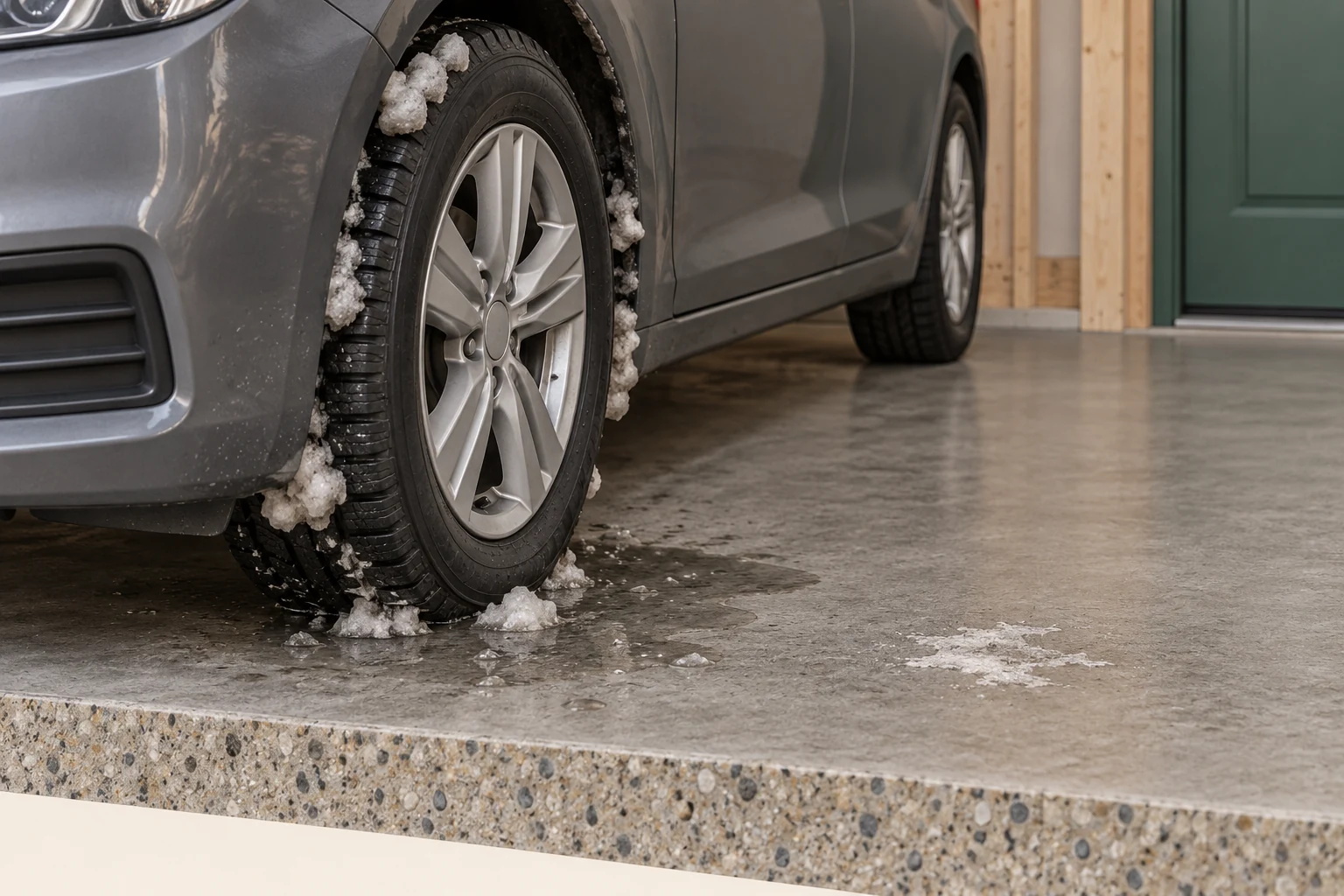
Yes. A vehicle can carry winter slush and residue from outside even when no deicer is spread inside the garage. Concrete Alberta identifies vehicle-carried salts as a possible concrete exposure route. The wheel illustration shows how a snowy vehicle and the surface below it can be connected in the history.
The source also describes surface scaling in relation to moisture, freezing and thawing, with construction and care factors affecting resistance. Those mechanisms make exposure history useful. They do not establish that a particular pale mark is salt, that this slab froze or that salt caused its condition.
Describe the visible material and events without assigning a chemical name. The picture’s pale dry-looking patch is not a laboratory identification or concentration measurement. Likewise, its illustrative concrete edge establishes no reinforcement, approved thickness or hidden protective layer.
Keep the builder’s or actual product’s care instructions and any assessment with the log. Ask the appropriate concrete provider about the identified surface and exposure before choosing chemicals or treatment. This guide supplies no deicer, cleaner, sealer or repair recipe.
A snowy wheel can carry exposure inside
A snowy wheel, nearby wetness and a separate pale dry-looking mark, with timber and a green door edge in the background.
Numbers identify the parts explained below.
- Carried material
Snow and slush are visible around the illustrated wheel; this suggests a possible history to document.
- Wet surface
The wet area is visible but does not establish its quantity, timing or destination.
- Pale mark
Appearance does not identify salt or another material, or prove damage.
- Actual assessment
Keep dates and exposure history; ask the qualified provider to identify the relevant surface question.
What does this illustration leave out?
No residue chemistry, concentration, freezing history, damage cause, reinforcement, structural finding or actual home is established. Illustrative model only. Colour does not identify the residue or cause.
What does the arrival history establish, and what material remains unidentified?
Explore this with HomeAI ↗Opens an editable question. Nothing is sent until you choose to send it.Are a pale mark, loose powder and missing surface material the same?
Start with what is visible: a pale mark on top, powder reported during ordinary use, a fine crack pattern, or areas where surface material appears missing. Those descriptions preserve useful differences without claiming a cause. A single picture may not establish whether material is on the surface or part of it.
Concrete Alberta uses dusting for powdering of the wearing surface, scaling for a flaking or peeling process, and crazing for a particular fine surface-crack pattern. A qualified assessment must establish whether those terms fit this actual floor. They are not interchangeable names for every rough patch or crack.
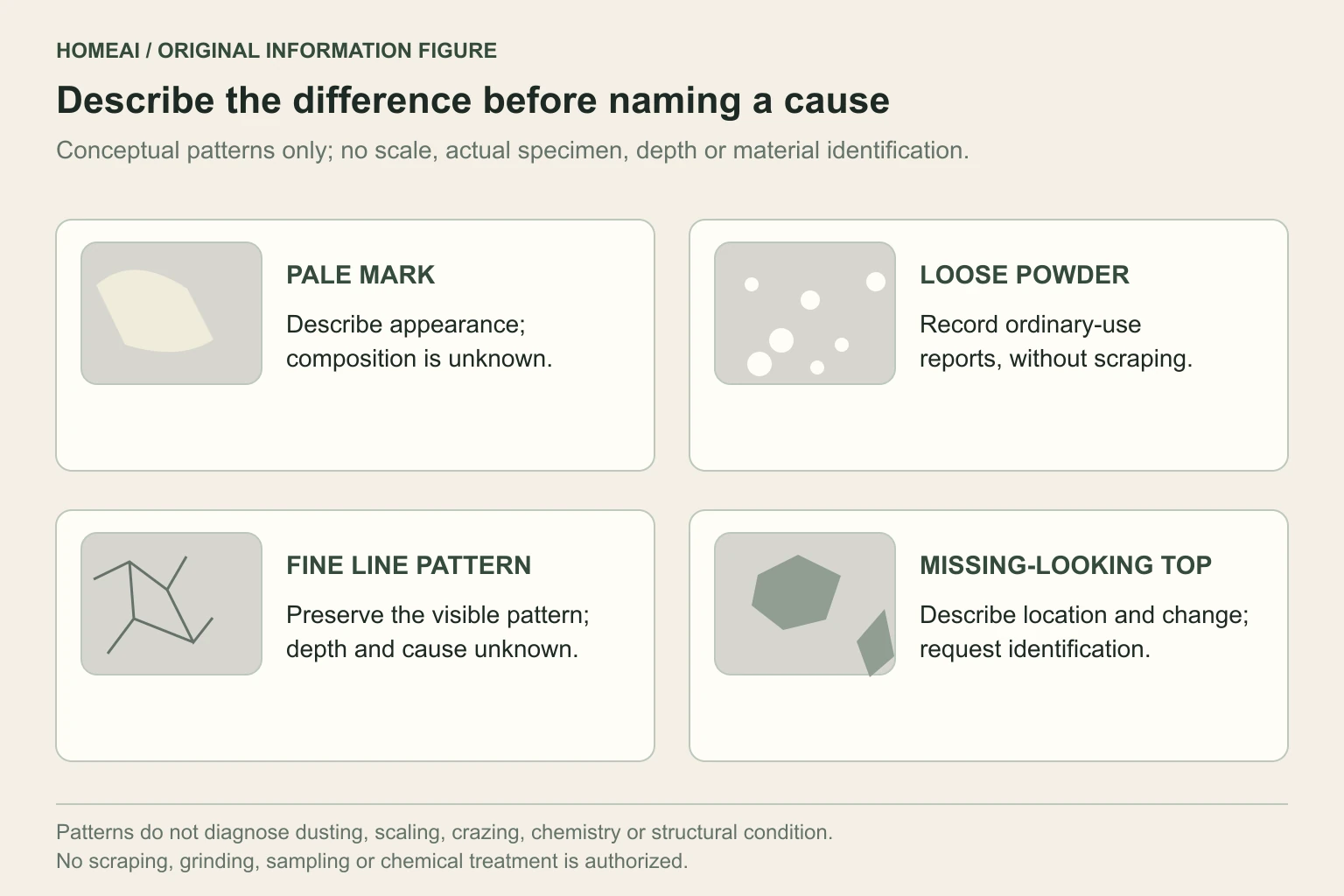
The four-panel information figure is a conceptual comparison, with no scale or real specimen. Its patterns show which observations to keep separate. It supplies no material identification, depth, strength, chemical exposure or structural conclusion.
Preserve safe overview and closer photographs with dates and locations where access permits. Do not scratch, grind, scrape or apply reagents to identify the surface. Ask the provider which observations, construction records and appropriately selected tests can distinguish the relevant possibilities.
Four observations need different descriptions
Four visibly different abstract patterns with descriptive labels rather than property diagnoses.
Numbers identify the parts explained below.
- Pale surface mark
Describe the appearance and location; composition and whether it is a deposit remain questions.
- Reported loose powder
Record what happens in ordinary use; do not scrape or grind to produce a sample.
- Fine visible pattern
Preserve the pattern without assigning depth, cause or structural significance.
- Missing-looking material
Describe the area and change, then request appropriate identification and scope.
What does this illustration leave out?
No chemical, actual concrete condition, measured crack depth, scaling or dusting diagnosis, strength or structural conclusion is shown. Conceptual patterns without scale; no diagnosis or sampling instructions.
Which observation is actually present, and what evidence would distinguish it?
Explore this with HomeAI ↗Opens an editable question. Nothing is sent until you choose to send it.Four observations need different descriptions
These abstract patterns separate observation words. They are not actual specimens, diagnoses or scaled concrete details.
| Visible or reported observation | Useful record | Question left open |
|---|---|---|
| Pale mark | Appearance, location and dated ordinary history. | Composition, deposit versus surface change, and relevance to condition. |
| Loose powder reported during use | Who observed it, where and under which ordinary use. | Whether concrete dusting or another material explains it. |
| Fine visible line pattern | Safe overview and location record without assigning depth. | Whether an identified crazing pattern or another process fits, and what its significance is. |
| Missing-looking surface material | Location, appearance and reported change over time. | Whether scaling or another condition fits and which construction or exposure evidence matters. |
Concrete Alberta’s retained 2025 tips explain dusting, scaling and crazing as technical concepts. The provider must identify the actual condition. No chemical, crack depth, structural clearance, destructive sampling, scraping or treatment instruction is supplied.
Describe the surface before assigning a technical term
- Pale mark or depositRecord its visible appearance and location; composition and relationship to the concrete remain questions.
- Powder reported in ordinary usePreserve the observation; a provider establishes whether concrete dusting or another source explains it.
- Fine crack patternRecord the pattern without assigning depth, cause or structural significance from a picture.
- Missing or flaking-looking materialAsk whether the identified condition is scaling or another process and which exposure or construction evidence matters.
Does the surface tell me whether the whole floor is structurally sound?
The wearing surface, moisture condition and load-supporting arrangement are related questions with different evidence. A surface-treatment proposal does not automatically assess structural capacity. Conversely, a visible surface problem does not by itself establish a failed structural floor.
First establish the actual arrangement from records and qualified assessment. A slab supported by ground differs from a suspended garage or parking floor above another space. In a shared building, ask the manager which records, responsibilities and structural scope apply; do not assume every garage is an ordinary on-ground slab.
Describe changes such as developing cracks or changed door operation without assigning their cause. Loose material above an occupied area or other concerning conditions need appropriate hazard controls and assessment. Keep people away from a suspect hazardous area rather than trying to prove its strength by loading or striking it.
Ask whether the question needs a concrete-surface provider, a structural professional or both. Retain their actual scope and limitations. This guide gives no universal crack-width limit, load allowance, structural clearance or owner test.
Why does a coating proposal need moisture and surface evidence?
A coating must bond to the material receiving it, often called the substrate. Changing the appearance of a floor does not itself resolve the source of water or establish that the surface can support the proposed finish. Ask about the concrete and wetting history before treating a coating as the whole answer.
Concrete Alberta’s retained moisture tip explains that moisture can interfere with floor-covering or coating adhesion. Its 2019 edition is general technical education. The actual proposed product, current manufacturer requirements, floor arrangement and assessment determine the project’s appropriate preparation and acceptance questions.
A dry-looking top does not establish the moisture condition within a slab. Different tests sample different quantities, places and conditions. Ask the provider to name the method, location, conditions and product-specific criteria, and explain what the result cannot show about future wetting or the wider floor.
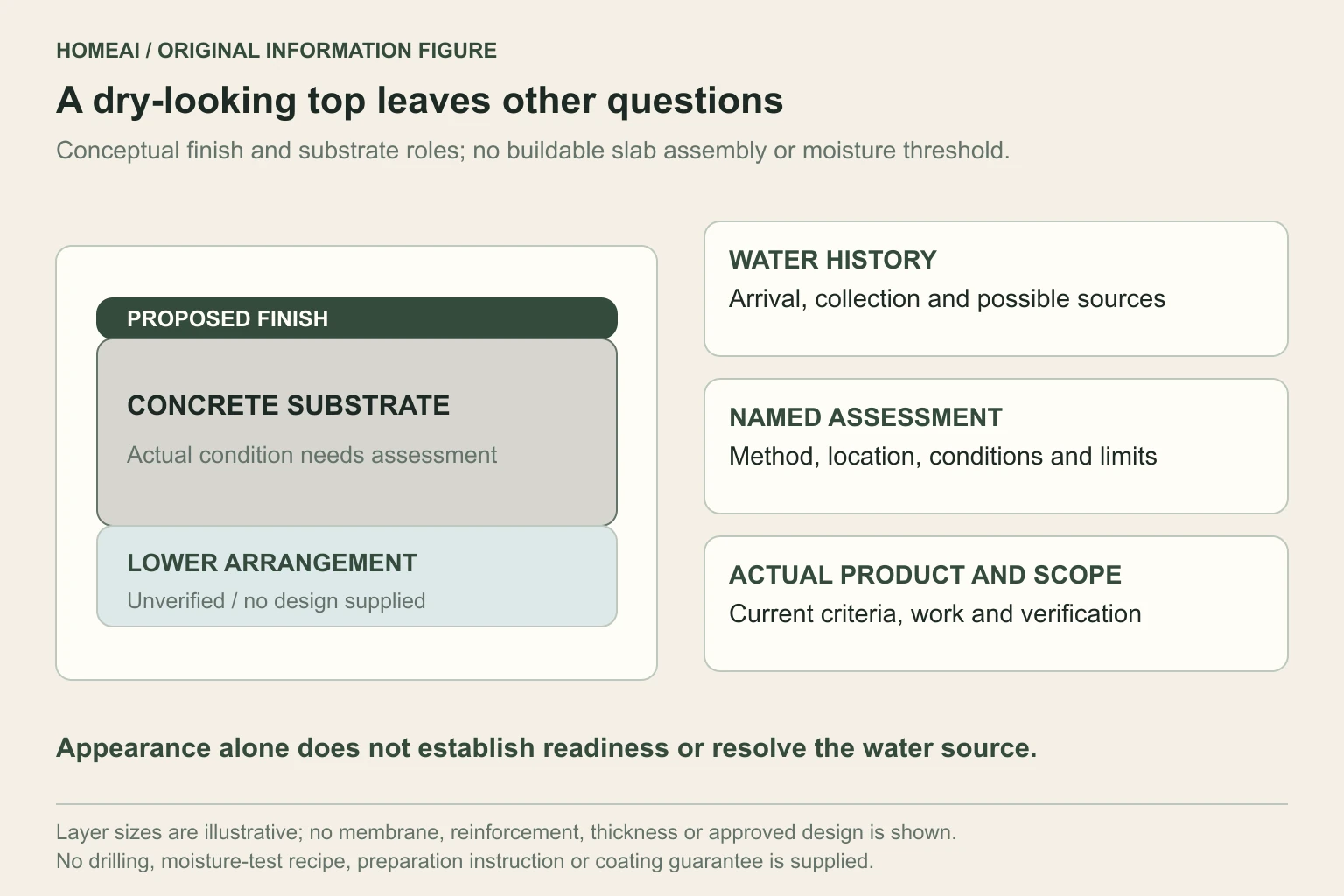
Keep the water-source question, substrate assessment and finish proposal separate in the record, as the figure shows. Ask which work and follow-up each covers. This guide supplies no moisture threshold, drilling or plastic-sheet test, surface-preparation method, coating recommendation or performance guarantee.
A coating proposal needs more than a dry-looking top
A conceptual finish and concrete interface, plus record questions about water, test scope and the proposed product.
Numbers identify the parts explained below.
- Water history
Where and when wetness arrives; keep possible sources and future-event limits explicit.
- Concrete substrate
The actual material and condition receiving the finish need assessment beyond appearance.
- Named measurement
Ask about method, location, conditions and its product-specific purpose and limitations.
- Actual product and scope
Retain manufacturer criteria, included work, exclusions and relevant verification; no generic threshold is supplied.
What does this illustration leave out?
No slab design, actual moisture, hidden layers, acceptable threshold, coating suitability, preparation method or guaranteed result is represented. Conceptual layer roles, with no dimensions, approved assembly or test recipe.
Which actual product requirement and water question does this proposal address?
Explore this with HomeAI ↗Opens an editable question. Nothing is sent until you choose to send it.A coating proposal needs more than a dry-looking top
A proposed finish has to relate to the actual substrate and product requirements. Keep those questions beside the arrival history rather than treating dry appearance as acceptance.
- Water history
- Retain first wet location, timing, weather and vehicle context. Keep unverified sources and future-event limits explicit.
- Actual floor arrangement
- Establish the relevant slab and support arrangement from records and qualified scope. The illustrated layers are roles, not an actual section.
- Substrate condition
- Ask how the receiving concrete is identified and assessed for the proposed finish. Surface appearance does not establish structural condition or readiness.
- Named measurement and limits
- Ask for actual method, sampled locations, conditions and purpose. Different measurements do not necessarily answer the same question, and one result does not prove every future wetting condition.
- Product-specific proposal
- Retain the actual product, current manufacturer criteria, included preparation and work, exclusions and relevant verification records.
- Separate route or discharge question
- A drainage change needs its own established connection and actual municipal guidance. No drain or approved destination is drawn here.
Conceptual unscaled layer roles only. Concrete Alberta’s moisture tip is the retained 2019 edition; its historical numerical tests, thresholds and recipes are not adopted. No hidden membrane, thickness, coating recommendation, drilled test, preparation procedure or result guarantee is supplied.
Keep water, surface and finish questions connected
- Water historyWhere and when wetness first appeared; chronology alone does not establish every source or future event.
- Concrete and moisture assessmentNamed methods, locations, conditions and limits; appearance alone does not establish coating acceptance or structure.
- Proposed coatingActual product, defined scope, manufacturer criteria and exclusions; no generic finish solves every water problem.
- Drainage or dischargeAn established connection and actual local rules need their own qualified scope; a visible opening does not prove destination or permission.
Where would collected water or cleaning residue actually go?
A visible opening does not prove the destination of a garage drain. Ask a qualified plumbing provider and the applicable municipality what the actual connection is and which rules apply. Keep that answer with its address, date and scope before relying on the opening for a cleaning or drainage plan.
Calgary’s guide advises sweeping garage and driveway debris rather than washing it away. Its stormwater page identifies materials that must not enter that city’s stormwater system. Those are local source examples; they do not create nationwide washing permission or identify a private garage connection.
Do not open or modify a drain, redirect water onto another property or create an icy route while investigating. If water contains sewage or an unknown spill, treat that as a distinct hazard requiring the appropriate response and qualified help. A routine care task is not a reason to enter contaminated water.
Ask who assesses the route, who determines permissible handling and what project approval may be needed. A proposed floor finish, a drainage alteration and waste handling have different scopes. HomeAI explains the questions without approving a discharge, slope or connection.
When should I stop recording and respond to a hazard?
Keep ordinary observations to dry, accessible positions. Ice, electrical equipment near water, sewage or unknown chemicals can change what is safe. Stop and obtain the appropriate help instead of collecting a closer photograph or trying an improvised cleaning or drying method.
Health Canada advises never idling a vehicle in a garage, even with the garage door open, and keeping the adjoining house door closed. Do not operate fuel-powered generators or other outdoor fuel-powered equipment inside a garage. An open door does not turn that space into a safe location for those activities.
If a CO alarm sounds, leave immediately for fresh air and call 911 or the fire or emergency service from outside. Do not search for the source. Do not return until the problem has been fixed by a professional. Emergency action comes before finishing the moisture log or arranging surface work.
There is no owner grinding, chemical test, improvised heater or vehicle-running experiment in this guide. Qualified providers manage the hazards and methods within their assignments. Keep their scope and safe-access limits with the record, so a later reader understands what was actually observed.
What does a useful fictional garage history show?
Fictional owner Arun records water beneath the parked vehicle after snowy journeys. During two rain events, the doorway corner is already wet before the vehicle arrives. The garage, events and observations are invented. He also notes a pale mark and a rough-looking threshold patch without identifying their materials.
The two arrival patterns justify different questions. Carried snow may contribute around the parking area, while the doorway timing supports a separate entry or collection investigation. The history does not prove a leak route, chemical damage or a particular drainage failure.
Arun asks the appropriate concrete and site or enclosure providers to define their assessments before selecting a finish. He preserves the locations, event descriptions, findings and proposed scopes. Any drain-destination question goes to qualified plumbing and municipal advice rather than being answered by a visible opening.
A later dry week is recorded as a dry week, not proof that every future storm or winter exposure is resolved. Where HAUSE coordination is available, Arun confirms the actual provider’s qualifications, scope and availability. No diagnosis, repair result, structural approval or real property is represented by this example.
Keep learning about the connected parts
Practice the distinction.
Vehicle wetness and a separate wet doorway
Fictional owner Arun has an invented garage and weather record: wetness follows snowy vehicle trips, while the doorway is wet before parking during two rain events.
Reported observations
- Wetness beneath the parked vehicle follows snowy journeys.
- The doorway corner is already wet before parking during the two invented rain events.
- A pale mark and a rough-looking threshold are described without identifying material or cause.
Compare the explanations
Expand each possibility to see the evidence needed to distinguish it. Similar symptoms can have different mechanisms.
Vehicle-linked exposure
Carried snow or slush may contribute beneath the parked vehicle; no residue chemistry is established.
A dated arrival and location record plus appropriate assessment.
A separate entry or collection question
The doorway timing supports further investigation, without proving a particular water route.
Qualified scope covering relevant site or enclosure information and its limits.
A useful next question
Coordinate the water-route and concrete-surface questions before selecting a finish or changing drainage.
No real property, chemical diagnosis, structural clearance, approved discharge, repair result or coating guarantee is represented.
Know what the words mean.
- Vehicle carry-in
- Snow, slush, water or residue transported inside on a vehicle; a possible route to compare with the ordinary arrival history.
- Wearing surface
- The traffic-exposed top of the floor; it does not by itself describe the whole slab or supporting arrangement.
- Dusting
- Concrete powdering at the wearing surface, when an actual assessment establishes that the technical term fits.
- Scaling
- A concrete flaking or peeling surface process, whose identification and relevant exposure or construction history require assessment.
- Substrate
- The material receiving a coating or repair; ask whether the actual condition meets that product’s requirements.
- Slab on ground
- A slab supported by underlying ground, distinct from a suspended structural floor above another space.
Questions to bring
to the conversation.
- Where was wetness first visible, and was that before or after parking or weather changed?
- What exactly appears on or missing from the surface, and what remains unidentified?
- Which floor arrangement, moisture assessment and actual product requirements does a proposal rely on?
- Which qualified provider establishes the water or drain route, applicable local rules and safe next scope?
Separate a showing observation, an existing record and a new professional assessment. Unknown means a question remains; it does not automatically mean a defect.
Use the evidence planner ↗Go to the source.
Original HomeAI explanation informed by these public references. Sources support the underlying guidance; they have not reviewed or endorsed HomeAI. Diagrams are conceptual, and calculator outputs depend on your inputs.
References read for this refresh on October 5, 2026. Complete Concrete Alberta dusting, scaling and crazing tips are the retained 2025 editions; slab-moisture tip is the retained 2019 edition. Calgary stormwater sources remain local and do not establish a private connection or discharge permission. Full current Health Canada CO guidance read October 5, 2026. No historical numerical tests, repair recipes or chemical/structural diagnosis is imported.
Publication & source review
First published .
Sources reviewed .
- Concrete Alberta · Scaling concrete surfaces
Where this reference applies
Jurisdiction: Alberta concrete-industry technical education; not a property assessment
Edition: Concrete Tech Tip 2; Reviewed and Revised 2025; publisher index says updated December 2025; 2 PDF pages
Surface scaling, freeze/thaw and moisture exposure, vehicle-carried salts, and the importance of a sound repair substrate. Mix proportions, finishing, surface removal, sealer selection and repair procedures are not reproduced.
- Concrete Alberta · Dusting concrete surfaces
Where this reference applies
Jurisdiction: Alberta concrete-industry technical education; not a property assessment
Edition: Concrete Tech Tip 1; Reviewed and Revised 2025; publisher index says updated December 2025; 2 PDF pages
Powdering associated with a weak wearing surface and construction/curing context. A photograph cannot establish mix quality, installed strength, construction cause or liability; installation and repair procedures are excluded.
- Concrete Alberta · Crazing concrete surfaces
Where this reference applies
Jurisdiction: Alberta concrete-industry technical education; not a property assessment
Edition: Concrete Tech Tip 3; Reviewed and Revised 2025; publisher index says updated December 2025; 2 PDF pages
Fine surface-pattern cracking as distinct terminology. Published dimensions and general statements about identified crazing are not an identification or structural clearance for an observed garage crack.
- Concrete Alberta · Concrete slab moisture
Where this reference applies
Jurisdiction: Alberta concrete-industry technical education; historical general slab/floor-covering reference
Edition: Concrete Tech Tip 28; Reviewed and Revised 2019; 2 PDF pages
Moisture can affect floor-covering/coating adhesion; original mixing water and below-slab sources require different questions. Historical design dimensions, drying times, test thresholds and sampling/installation procedures are excluded.
- City of Calgary · Homeowner water guide: stormwater management
Where this reference applies
Jurisdiction: Calgary, Alberta; local stormwater education
Edition: 4 PDF pages; document code 18-01036238; publication date not established from the code
Hard-surface rain/snowmelt runoff, polluted runoff and sweeping garage/driveway debris instead of washing it away. Historical infrastructure/population counts and site-specific drainage design are excluded.
- City of Calgary · Bylaws related to stormwater
Where this reference applies
Jurisdiction: Calgary, Alberta; municipal guidance, not a national discharge rule
Stormwater destination and prohibited pollutants, including oil, solvents and detergents. No garage-drain destination, cleaning permission, bylaw compliance or national rule is inferred.
- Health Canada · Carbon monoxide: preventing exposure
Where this reference applies
Jurisdiction: Canada; home health and immediate CO safety guidance
Publisher publication date: 2024-11-12
Publisher modification date: 2024-11-12
No vehicle idling in a garage even with its door open; no fuel-burning generator or outdoor fuel-powered equipment there; leave immediately and call emergency assistance from outside for a CO alarm. No heating or ventilation system is specified.
Have a question about your home?
Start with the symptom, timing and what you have observed.
Ask HomeAI