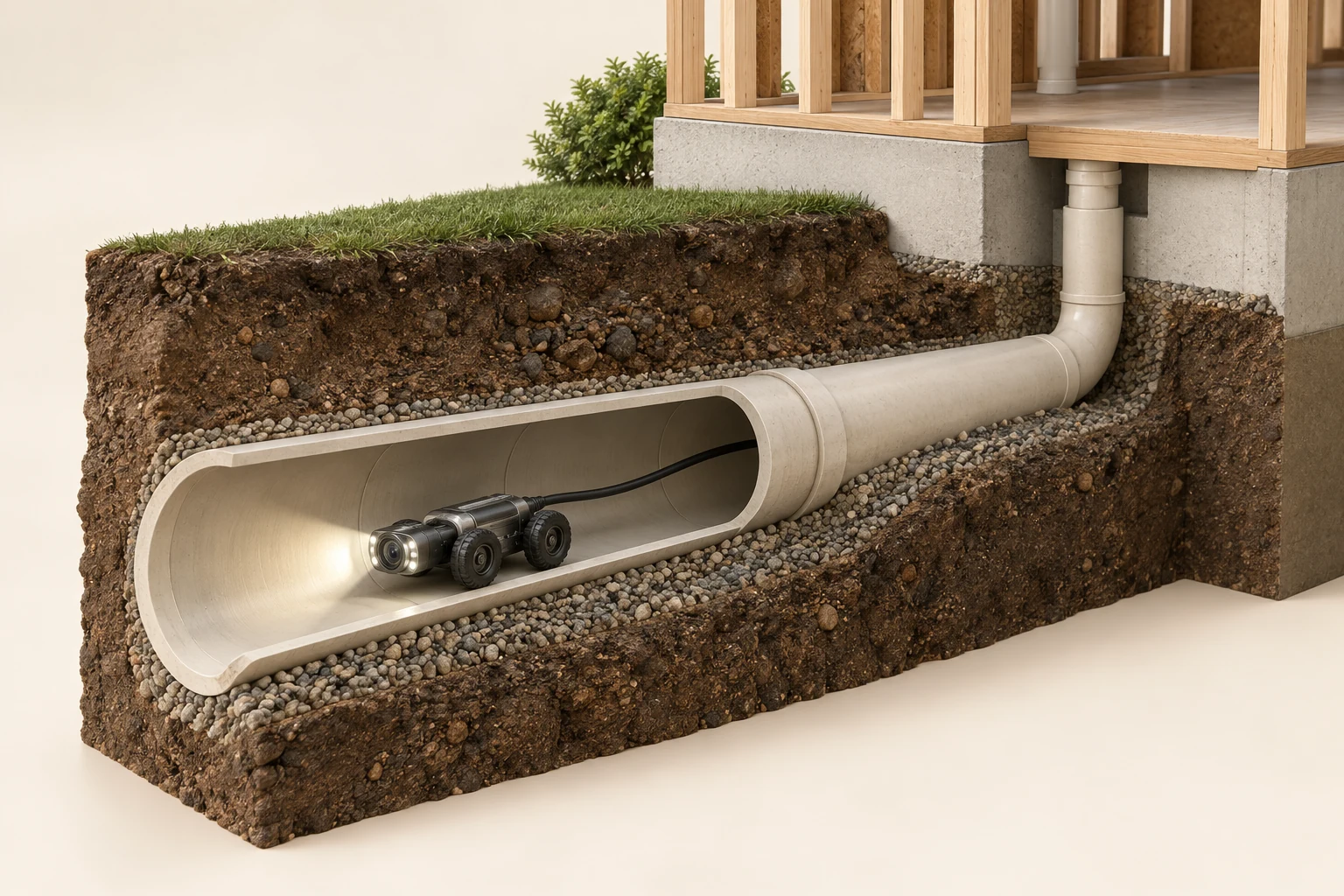
Follow a camera through an illustrated drain. Change how far it travels and how much of the image is clear, then separate what was seen from what still needs an answer.
Inside the pipe is one view. Support outside it is another. This is a conceptual picture of one camera arrangement; actual equipment, access and installation differ. Enlarge picture ↗
01 / REACH ≠ VISIBILITY
A camera pass has limits.
This fictional 24 m run teaches report scope. It is not a utility locate, a drainage design or an estimate of your property.
Interactive controls are unavailable. You can still read the illustrated example and complete lesson below.
On narrow screens, scroll the pipe illustration horizontally. The lengths and ribbon below describe the full illustrated run.
In this 24 m illustration, the camera reaches 16 m: 12 m has the selected clear view, 4 m has restricted visibility and 8 m is not reached. These lengths do not establish external support, cause or responsibility.
Selected clear view
12 m
Restricted view
4 m
Not reached
8 m
A clear image still needs professional interpretation. Water, deposits or obstructions can restrict a view; the last-part setting simply demonstrates that limit. Ask for the actual access point, endpoint, distance method, complete footage, written interpretation and obscured or inaccessible sections. The illustration does not identify a defect or certify pipe condition.
02 / DIFFERENT QUESTIONS, DIFFERENT EVIDENCE
Clear footage does not clear every question.
UNRESOLVED BY THIS CAMERA VIEW
External support remains unresolved.
A clearer or longer recording does not verify soil support, bedding, cover or concealed installation details. For flexible buried pipe, the pipe and installed soil support work together. Ask which property-specific records or qualified assessment address the external question; the skeleton illustration supplies none of that evidence.
UNRESOLVED BY THIS CAMERA VIEW
Cause remains unresolved.
A camera may document an interior consequence, but it does not prove how or when it arose. Construction loads can matter depending on the pipe, cover, support, installation and actual loading. An equipment crossing or fictional deformation is not proof of damage, and further investigation is not automatically excavation or a geotechnical test.
UNRESOLVED BY THIS CAMERA VIEW
Responsibility remains unresolved.
Neither the lesson nor a camera finding decides who owns, maintains or pays for a segment. Local boundaries and the relevant contract or warranty scope must be considered separately with the appropriate parties and advisers. A technical report supports its documented scope rather than a universal liability conclusion.
03 / READ THE CLAIM
What kind of evidence would answer it?
Open each claim to see the difference between an observation, a measurement, an explanation and responsibility.
Which interior surfaces are actually visible?VISIBLE OBSERVATION
The lesson separates an accessible recorded length from a usable view. Real footage may show visible joint offsets, deposits, water or deformation where the camera can see them. Record the inspected segment and visibility limits; a selected image does not establish unseen sections or the surrounding installation.
Was position or grade measured separately?SEPARATE MEASUREMENT
A camera distance reference describes progress along the pipe; it is not automatically a surface map or depth measurement. Ordinary footage, including visible water, does not quantify the whole grade. Some specialist services add locating, route or elevation measurements. Ask which method, checked accuracy and inspected extent the provider actually supplies.
What would connect an observation to its cause?CAUSAL INTERPRETATION
A visible interior condition and its cause are different questions. Footage alone does not reconstruct construction loads, bedding or every change over time. Give a qualified reviewer the available chronology and relevant installation or protection records; ask which specific follow-up could distinguish the explanations. The fictional scene does not demonstrate truck damage.
What establishes the maintenance or payment boundary?RESPONSIBILITY EVIDENCE
An image, a servicing plan or a municipal inspection record alone does not assign who must pay. Confirm local ownership and maintenance boundaries, shared-service arrangements where relevant, and applicable contract or warranty terms with the relevant parties and advisers. Technical condition, causation and responsibility need their own evidence.
04 / YOUR NEXT CONVERSATION
Bring a question with a useful scope.
Make the service question precise.
What was reached, what could be seen, and which remaining question matters for the symptom or maintenance decision?