- Snow depth does not establish roof load or structural capacity.
- Ice-dam, water-entry and structural questions need distinct assessment scopes.
- Stay off roofs and out of unsafe attic access; document conditions from safe locations.
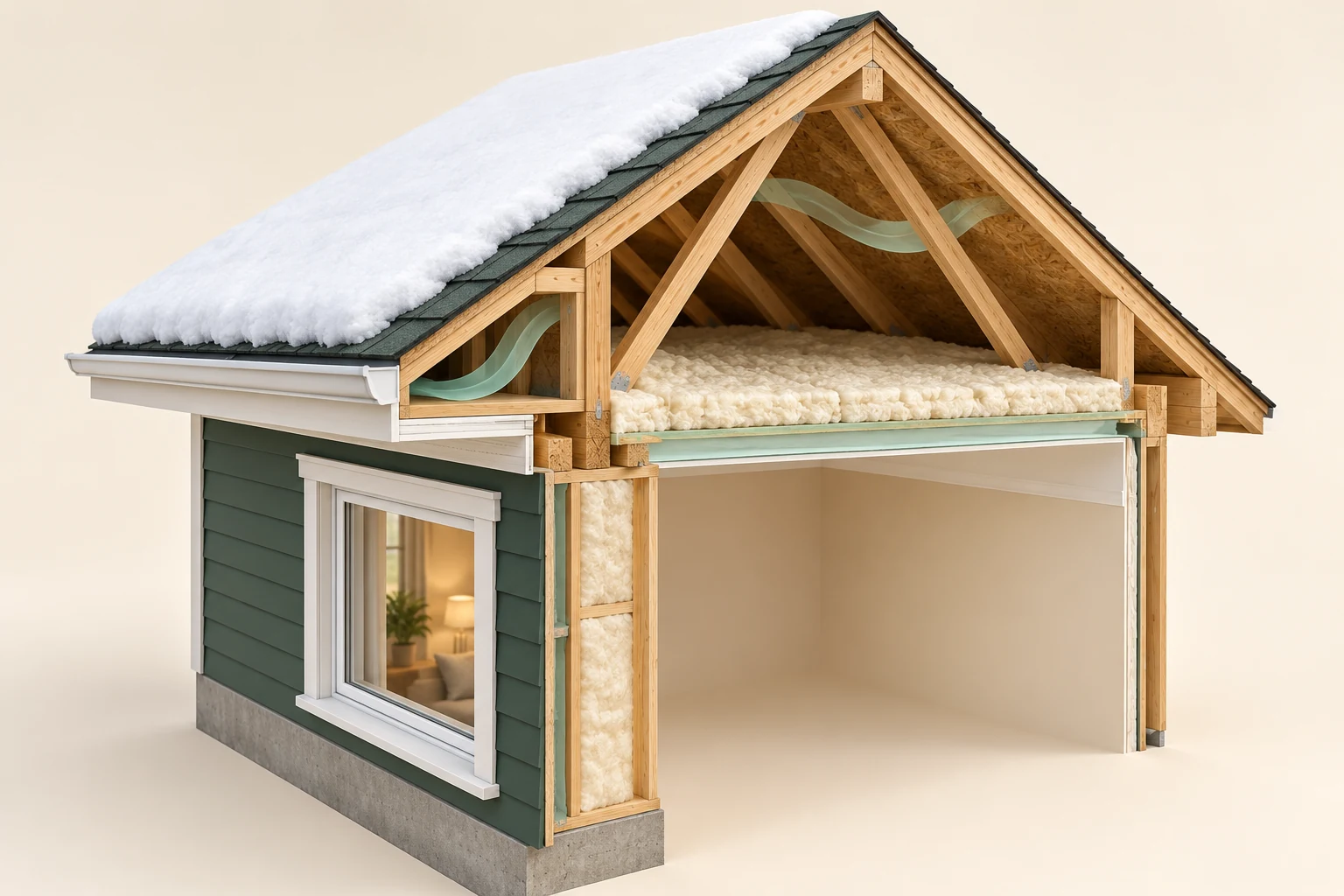
Conceptual architecture. Layout, sizes and routes are illustrative; the picture does not describe your home’s condition.
Explore this picture study ↗3 picture lessons appear beside the questions in this guide. Use them to understand the explanation, then consider what it means for your home.
Turn the winter photograph into several precise questions
A roof photograph can show snow distribution, visible ice and some geometry. It cannot establish snow density, concealed construction or remaining structural capacity. A stain inside the home is another observation with its own location and history. Begin by separating the possible questions: loading on the structure, water management at the roof surface, heat movement through the enclosure and safe access. Calling all four an ice-dam problem can conceal the evidence needed to understand the actual concern.
For a buyer, ask when the photograph or observation was made, what weather preceded it and which roof area it describes. Request the seller’s available repair and assessment records without expanding their account. A leak near one window during one event does not establish damage across the whole roof. A dry ceiling during a summer showing does not verify winter performance. Keep the dates and access restrictions attached to the inspection report so an attractive visible finish cannot silently answer a concealed or seasonal question.
Roof, heat and snow interact
The scene illustrates several interacting systems; it does not identify a cause or snow capacity.
Numbers identify the parts explained below.
- Roof conditions
Record location and timing from safe ground access.
- Ceiling interface
A stain does not establish roof versus condensation cause.
- Indoor conditions
Weather, indoor moisture and operation can matter together.
What does this illustration leave out?
Snow load, leak location, heat loss, moisture and structural adequacy require separate evidence. This illustration explains an idea. It is not an installation guide.
Which safe-ground observations and records distinguish snow, roof drainage and indoor moisture explanations?
Explore this with HomeAI ↗Opens an editable question. Nothing is sent until you choose to send it.Understand load without calculating a roof’s capacity yourself
The mass of a snow layer depends on its volume and density. Equal depths can represent different masses, and the roof distribution can be uneven. Drifting, roof geometry and changing conditions matter to a professional assessment. These mechanisms explain why a ruler, a neighbourhood photograph or a generic depth threshold cannot certify safety. Do not access the roof, probe snow or operate a ladder to estimate a live load. A suspected structural concern requires qualified evaluation and an appropriate immediate safety response.
Structural capacity is a separate question involving the actual members, connections, supports, condition and design assumptions. Ask for original structural information and records of changes such as additions, equipment, altered openings or roof work. A new roof covering does not establish that the structural design was reassessed. A specialist should explain what the available documents support and what requires investigation. If current conditions appear dangerous, keep people clear and contact emergency services or the appropriate building professional; do not wait for a transaction inspection to troubleshoot it.
Follow the ice-dam mechanism without assigning a cause
Natural Resources Canada describes how roof snow can melt over a warmer area and refreeze at a colder overhang, allowing an ice mass to obstruct drainage. Water may then back up where the roof assembly was intended to shed it. This is a mechanism to investigate, not proof that every icicle indicates an insulation defect. Weather, geometry and the actual enclosure arrangement belong in the assessment. An image of an ice edge cannot reveal the continuity of an air-control layer or every concealed flashing interface.
Ask the enclosure or roofing specialist which observations would distinguish the relevant possibilities. Dated interior and exterior records can help connect events, while appropriate inspection or testing can examine specific paths. Maintain the distinction between a plausible mechanism and an established water-entry route. Do not remove soffits, enter an attic or chip ice to test your theory. Those actions can create access, falling-object and material-damage hazards while failing to answer the underlying building question.
Request the complete roof assembly record
A roof is more than its visible covering. Ask what records describe the deck, supporting structure, insulation and air-control arrangement, drainage and interfaces at penetrations and adjoining walls. Some roofs have attics; others use assemblies with different access and ventilation arrangements. Do not apply one diagram or one prescribed ventilation detail to every building. The correct assessment must identify the actual assembly and the conditions under which it is meant to function.
Repair documents should identify scope and location. A reroofing invoice might cover shingles and selected flashing, while a separate investigation might address concealed moisture or air leakage. Ask which layers were opened, what was observed and what was restored. Preserve any photographs and qualifications. A new product warranty is not automatically a warranty for every connection or for an unchanged structural system. Have the contractor and relevant advisors explain the actual written terms rather than relying on a broad description such as roof completely redone.
The covering is one part of the roof
Separate coverings, decks and timber supports are pictured. The low-slope specimen also shows a side outlet.
Numbers identify the parts explained below.
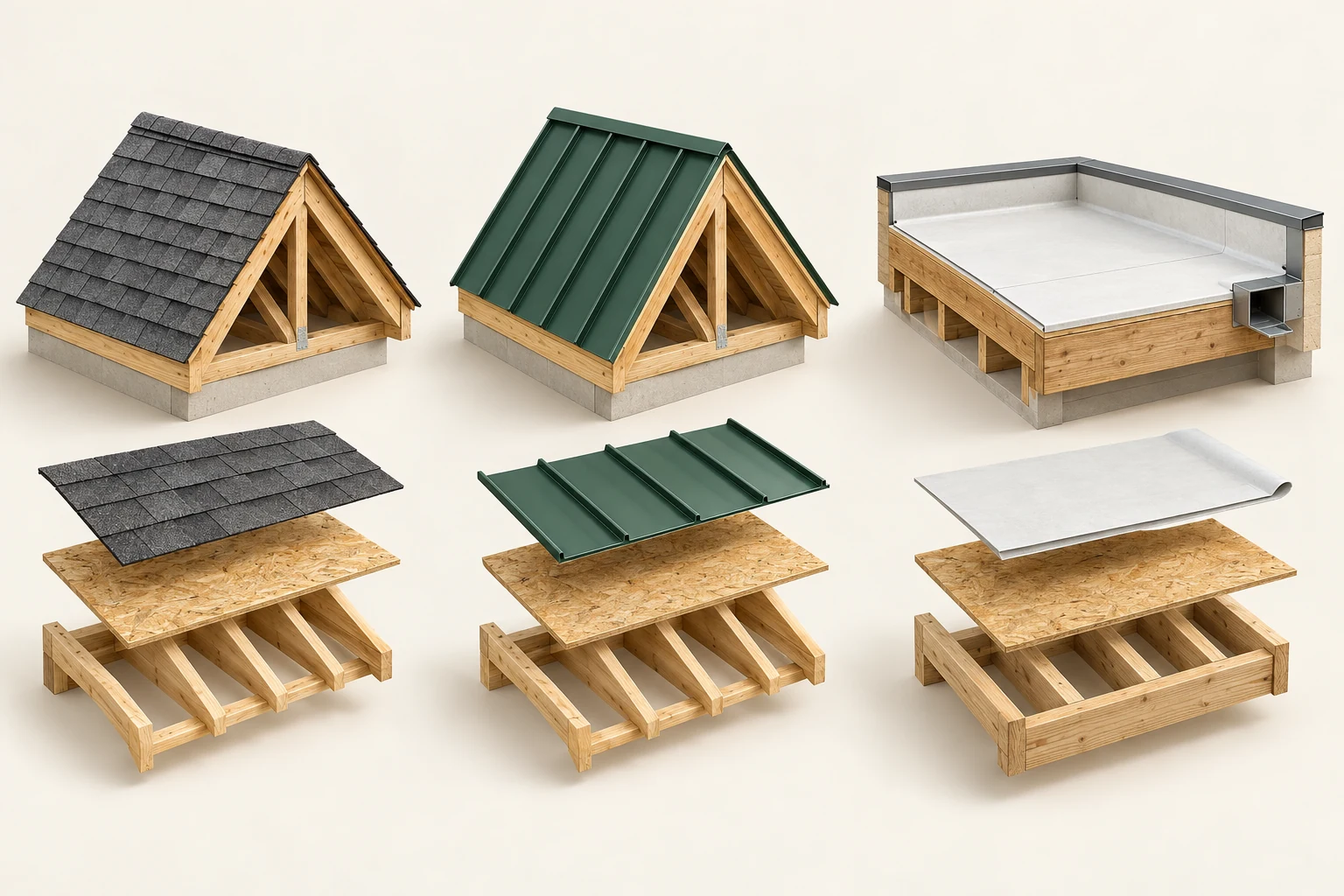
- Pitched coverings
Ask about the complete system, exposure, repair history and interfaces—not a universal lifespan.
- Metal specimen
Seams and connections need a product-specific explanation; colour does not identify the system.
- Low-slope outlet
Drainage, flashings and maintenance access are separate evidence questions.
What does this illustration leave out?
Underlays, insulation, vapour/air control, fasteners, slope, loads and drainage capacity are deliberately not a complete design. This illustration explains an idea. It is not an installation guide.
Which roof records and scoped observations explain the covering, drainage and hidden assembly of this home?
Explore this with HomeAI ↗Opens an editable question. Nothing is sent until you choose to send it.Connect attic evidence with the whole enclosure
Heat reaching a roof can involve conduction, air leakage and the actual operating conditions below. Moisture questions can involve more than one source as well. An insulation quantity alone does not prove air-control continuity, and adding ventilation is not a universal solution for every roof symptom. Give the specialist information about reported events, indoor use, equipment changes and available assembly records. Ask whether an enclosure investigation, energy evaluation or another scoped service fits the question.
Keep access safe and documented. A roof or attic may be excluded from a routine inspection because of condition, height, materials or restricted access. A report should say what was viewed and from where. Do not treat a photograph taken at an attic opening as a full review of every bay. If a specialist recommends further access, discuss permissions and methods through the proper arrangement. The purpose is a meaningful finding with limitations, not forcing an unsafe visit to produce a reassuring checkbox.
Trace the separate control layers
The separated planes help distinguish structure, insulation and weather-facing layers.
Numbers identify the parts explained below.
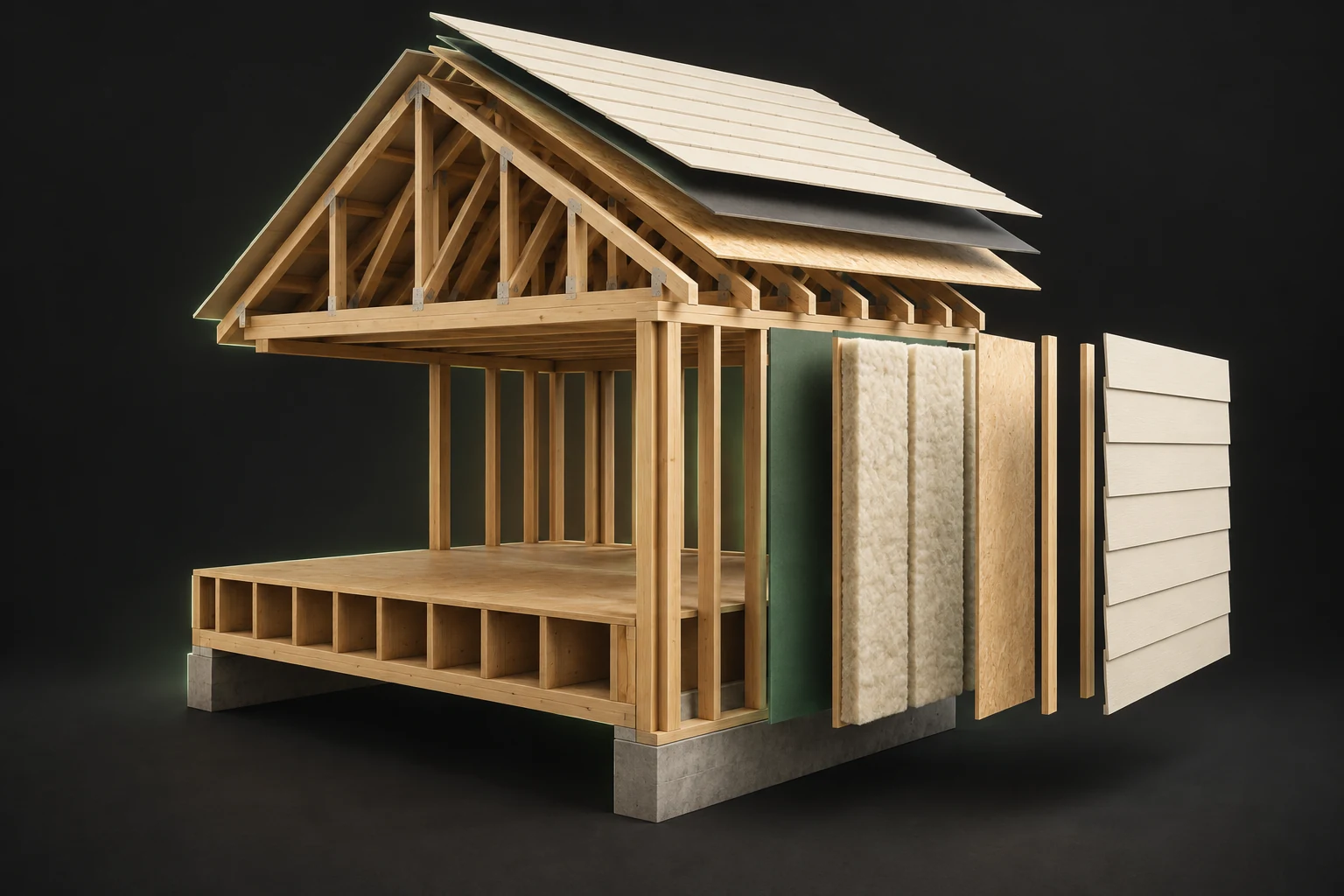
- Roof interface
Ask how the roof meets the wall and how that junction was assessed.
- Insulation space
Thickness in an illustration is not a performance rating.
- Exterior planes
A face finish does not reveal the air/water control behind it.
What does this illustration leave out?
Actual layer order, material specifications, junction continuity and moisture condition require records or assessment. This illustration explains an idea. It is not an installation guide.
Which records or qualified assessment explain the control-layer continuity and moisture limits of this assembly?
Explore this with HomeAI ↗Opens an editable question. Nothing is sent until you choose to send it.Review winter maintenance as a history, not a design certificate
Ask about prior snow or ice-removal work, why it was arranged and whether subsequent assessment or repair was documented. Québec’s official safety guidance recommends appropriate professional methods for this hazardous work; its advice should not become homeowner roof-access instructions. A removal receipt may document an event response without explaining the original mechanism. Repeated attendance can motivate a question, but it does not identify the cause or prove that a permanent correction was required or completed.
If a system such as a drainage accessory or heat cable is present, request its identity, installation information and operating instructions. Do not assume the accessory proves the enclosure is sound or that removing it would be safe. Ask the relevant qualified professional how it fits the actual roof and what inspection or maintenance is needed. Electrical and roof work require their own scopes. A buyer should understand what exists and the supporting record rather than experiment with equipment during a showing.
Make season and access part of the transaction plan
A snow-covered roof may limit inspection during the exact period when a buyer wants a decision. Ask early what the contracted assessment can cover, how inaccessible areas will be reported and whether existing seasonal evidence can help. Consider specialist scheduling, permission and report turnaround within the actual agreement timetable. A later view after snowmelt may answer some questions, but it is not guaranteed to reproduce the conditions behind a reported leak. Keep that distinction visible in the decision record.
Costs and insurance need their own evidence. Request an actual scoped proposal if investigation or work is recommended, including access and restoration assumptions. Ask the insurer about the exact address and proposed coverage; no guide can guarantee acceptance or infer coverage from a neighbouring house. Have the transaction professionals address conditions, responsibility and options. A repair allowance, a warranty and an engineering finding are different forms of information and should not be merged into one promise about future winter performance.
Use the findings to plan, without declaring universal winter risk
Canadian winter conditions vary by location and event, and buildings respond differently within the same neighbourhood. Use local climate and official warning information as context, then rely on building-specific records and appropriate assessment. Sellers can supply a clear history by preserving the full report, event dates, repair scope and remaining recommendations. Buyers can then distinguish ordinary maintenance planning from a consequential unknown about intended use or condition. Avoid province-wide labels that replace those details.
If you proceed, retain a safe maintenance and response plan suited to the actual roof and equipment. Know which observations warrant prompt professional help and whom to contact. Do not use this education to set a snow-depth trigger, certify a live roof or design a retrofit. HomeAI can help organize the evidence and explain why load, ice, heat and water are connected, but the assembly, capacity, cause and safe intervention remain questions for appropriately qualified people working within a defined scope.
When comparing proposals, ask each provider to identify which question their work addresses: event response, roof-covering repair, enclosure correction or structural assessment. If the scopes differ, the prices are not direct alternatives. Keep any immediate protective work distinct from investigation of cause and from a long-term correction. This prevents a transaction summary from describing ice removal as an insulation repair or new shingles as a structural upgrade that the documents never recorded.
Practice the distinction.
A winter stain and a summer showing
A fictional seller reports an eave-area stain after one winter event; the summer showing is dry.
Reported observations
- A prior photo shows ice at one edge.
- A covering invoice does not mention an enclosure investigation.
Compare the explanations
Expand each possibility to see the evidence needed to distinguish it. Similar symptoms can have different mechanisms.
Possible backup path
Ice-related water backup is one mechanism to evaluate.
Dated event history and a scoped roof/enclosure assessment.
Other unresolved interface
The stain might involve a different roof or wall connection.
Location-specific records and assessment of plausible routes.
A useful next question
Ask the specialist to distinguish the mechanisms and preserve winter-access limits.
The example does not identify a cause, a structural load or an unsafe roof.
Know what the words mean.
- Snow load
- The action of accumulated snow on a structure; depth alone does not establish it.
- Ice dam
- Ice that can obstruct meltwater drainage at a roof edge or another cold location.
- Assembly
- The actual connected roof layers, structure and interfaces, rather than the visible covering alone.
Questions to bring
to the conversation.
- Which part of the roof was visible, and what was snow-covered?
- Do records distinguish roof covering, drainage and structural work?
- What evidence connects the reported stain with its actual water route?
- Who can assess load or enclosure concerns under safe access conditions?
Separate a showing observation, an existing record and a new professional assessment. Unknown means a question remains; it does not automatically mean a defect.
Use the evidence planner ↗Go to the source.
Original HomeAI explanation informed by these public references. Sources support the underlying guidance; they have not reviewed or endorsed HomeAI. Diagrams are conceptual, and calculator outputs depend on your inputs.
Publication & source review
First published .
Have a question about your home?
Start with the symptom, timing and what you have observed.
Ask HomeAI